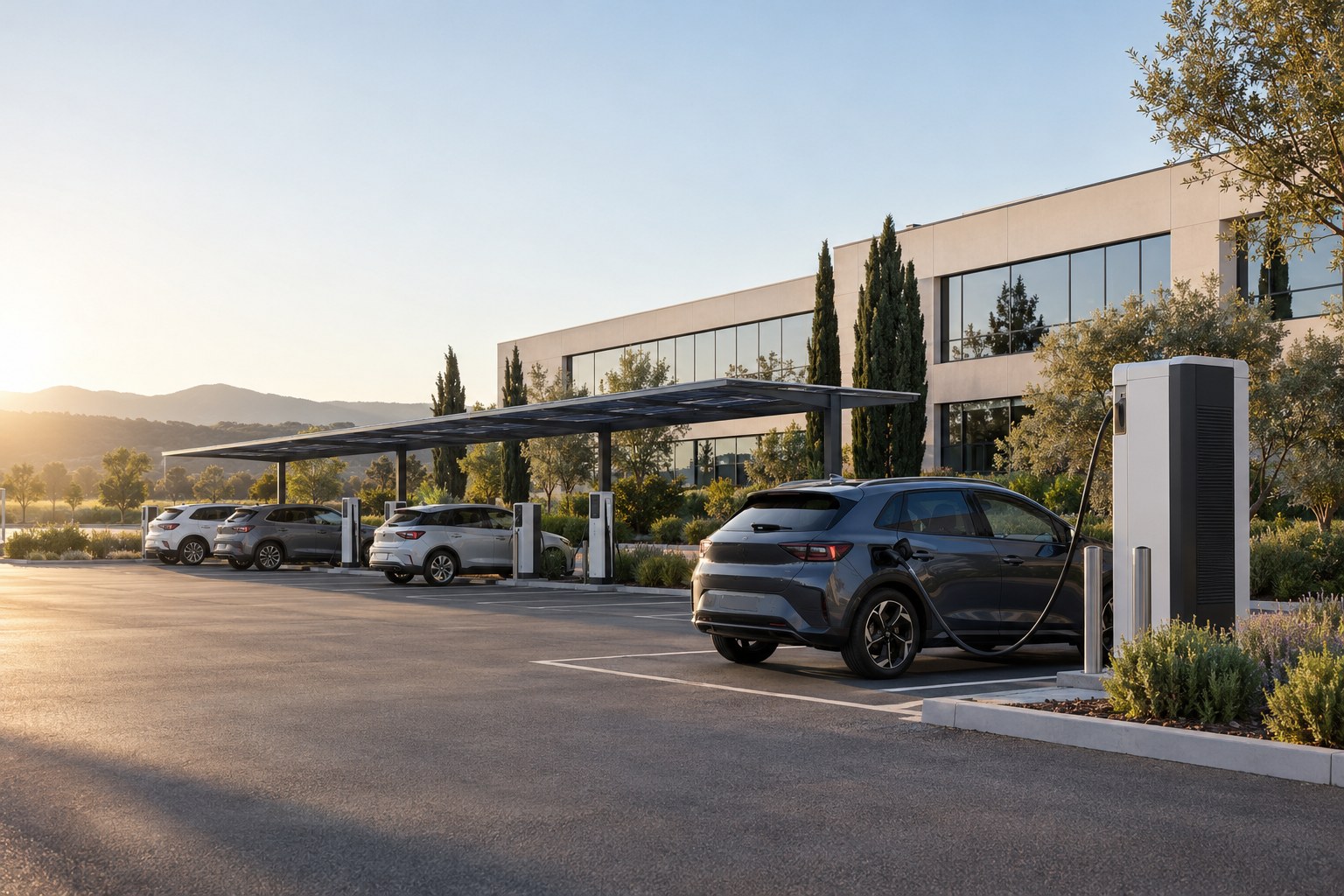
Corporate parking with AC and DC charging stations and photovoltaic covers

Business charging

Electric charging for companies:
AC and DC columns

The vehicles stop. Your business continues.

We design electric charging for companies around the people who use it: fleets, employees, guests, and customers. AC and DC charging points, power management, access, and digital services are selected together, based on the downtime times and the company’s infrastructure.

Who charges

Four contexts. Different needs.

01

Corporate fleets

The vehicles return with different consumption and schedules. The project starts with the energy to be replenished and subsequent departures, to choose the number of points, powers, and priorities. The useful question is: which vehicles must be ready, and when?
02

Employees and operational locations

The break during work provides time to distribute the recharge. Authorized access, usage rules, and power sharing help manage multiple cars without automatically adding up the maximum power of all the charging stations.

03

Hotels and accommodation facilities

Charging must be easy to find and use. We assess the length of stay, parking, guest access, and payment methods, distinguishing the service offered by the property from any services provided by the platform.

04

Retail and parking for customers

The stops can be short and variable. AC, DC, or a combination are evaluated based on the energy required, the rotation of the seats, and the electrical availability. Public opening and payments are included in the project from the very beginning.

AC and DC

The time of rest guides the choice.

Charging stops and choice between AC and DC chargingCharging stops and choice between AC and DC charging TIME, VEHICLE, SITEThe stop guides the choiceACDCLonger stopsWork · nightDestinationsReduced timeframesRotation · operationalityMore energy in less timeVehicle · energy · power of the site

AC — when the vehicle can stay. The alternating current is converted by the car’s onboard charger. This is a solution to consider for offices, overnight stays, and vehicles that are stationary for several hours. A 22 kW charging point does not provide 22 kW to a vehicle that in AC mode accepts a maximum of 11 kW.

DC — when the restart matters. The conversion takes place at the station, which provides continuous current to the vehicle. It can handle shorter stops or high demands, with adequate infrastructure. The accepted power, charge status, and battery temperature influence the session: the maximum value is not constant from start to finish.

A site can have both: AC points for long stops and DC points for operational needs that justify them.

Energy, power, operability

First the energy. Then the power.

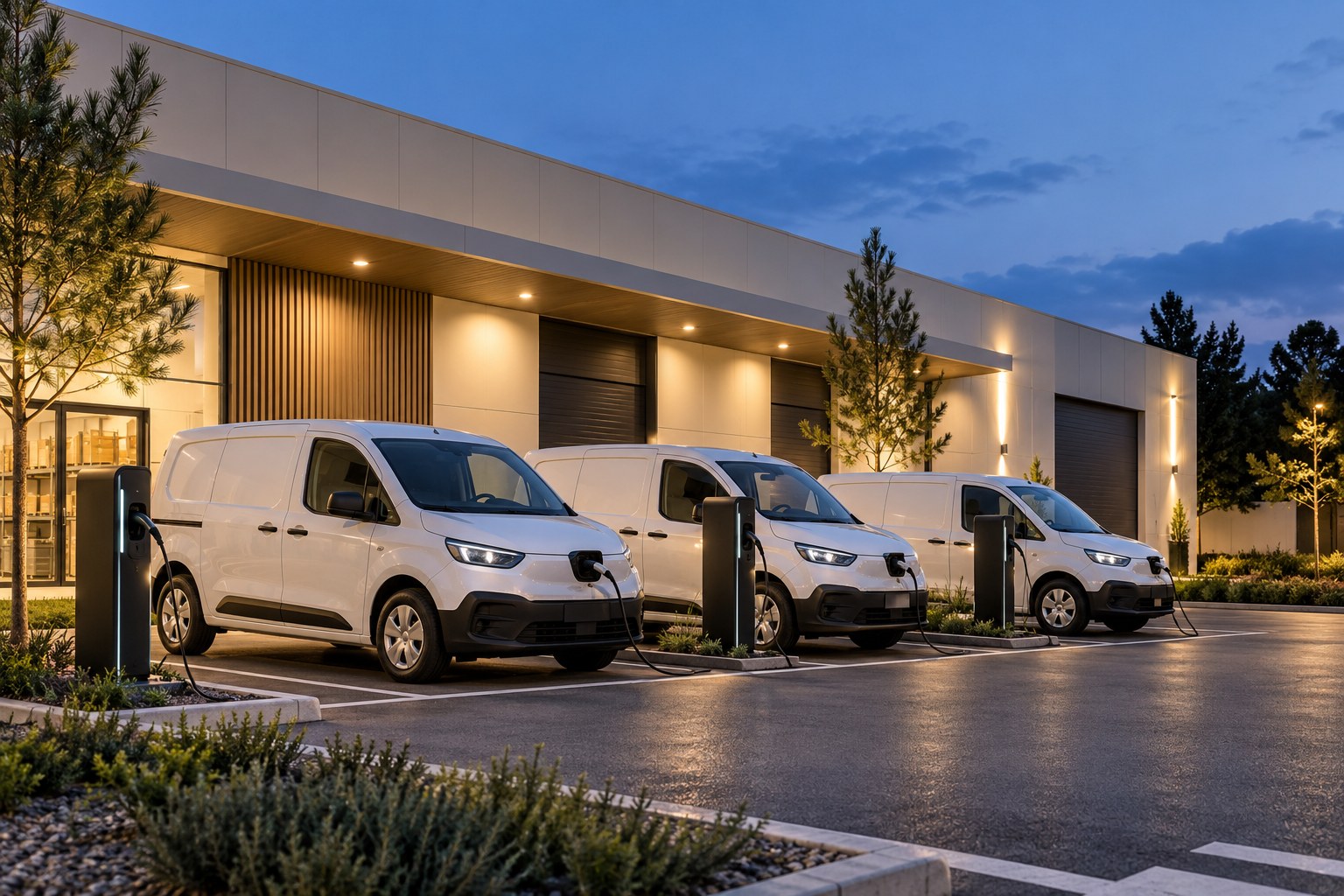
Electric vans connected to the charging stations in the company depot

I kWh They indicate how much energy is being delivered; the kW how quickly. Both are needed to size the charging, along with the actual hours of connection.

22 kWh in 8 hours

2,75 Average kW

22 kWh in 2 hours

11 Average kW

The project translates trips and stops into a daily requirement, taking into account the most demanding days as well.

Calculation scenario at the charging point: energy divided by time. For the energy stored in the vehicle, losses, power variations, and margins are also necessary; these values are not guaranteed recharge times.

Managing the available power

Four points. A power to be shared.

Dynamic power distributionIllustrative scenario. Real limits of phase, current, system and vehicle to be verified. [(36, 44), (58, 22)] ILLUSTRATIVE SCENARIOSite limit: 80 kWOTHER LOWER CONSUMPTION36 kW other loads44 kW chargingOTHER CONSUMES MORE58 kW other loads22 kW charging4 points: 11 → 5.5 kW eachUniform distribution in the scenario

Dynamic management measures the building’s consumption and adjusts the margin allocated to the cars. With compatible devices and controls, the points can redistribute the available power or follow agreed priorities.

In a scenario with a site threshold 80 kW, If the other loads absorb 36 kW, They remain 44 kWFour compatible vehicles can receive 11 kW each. When the other charges rise to 58 kW, The margin drops to 22 kW, equivalent to 5.5 kW per vehicle with uniform distribution.

These are rounded values of an ideal three-phase scenario. Currents per phase occur in the project, minimum vehicle limits, safety margins, and behavior in the absence of communication. The management distributes the available capacity: it does not create additional energy or power.

Energy and charging

Photovoltaic energy, storage and cars in the same project.

The charging point enters the energy system of the premises.

Using the available production

When cars are connected during solar production, a compatible control can prioritize the available energy over other consumption. It determines whether to wait for the surplus or also use the grid to meet charging targets.

Evaluating an accumulation

A BESS can be evaluated to move energy over time or to support part of the demand during the most demanding times. However, available power, usable energy, state of charge, and a strategy consistent with the work of the site are needed. The presence of a battery does not automatically make it possible to recharge during a blackout.

Accesses and permissions

Simple access. Clear rules.

Who can use each point? At what times? With what priority? The answers guide the configuration.

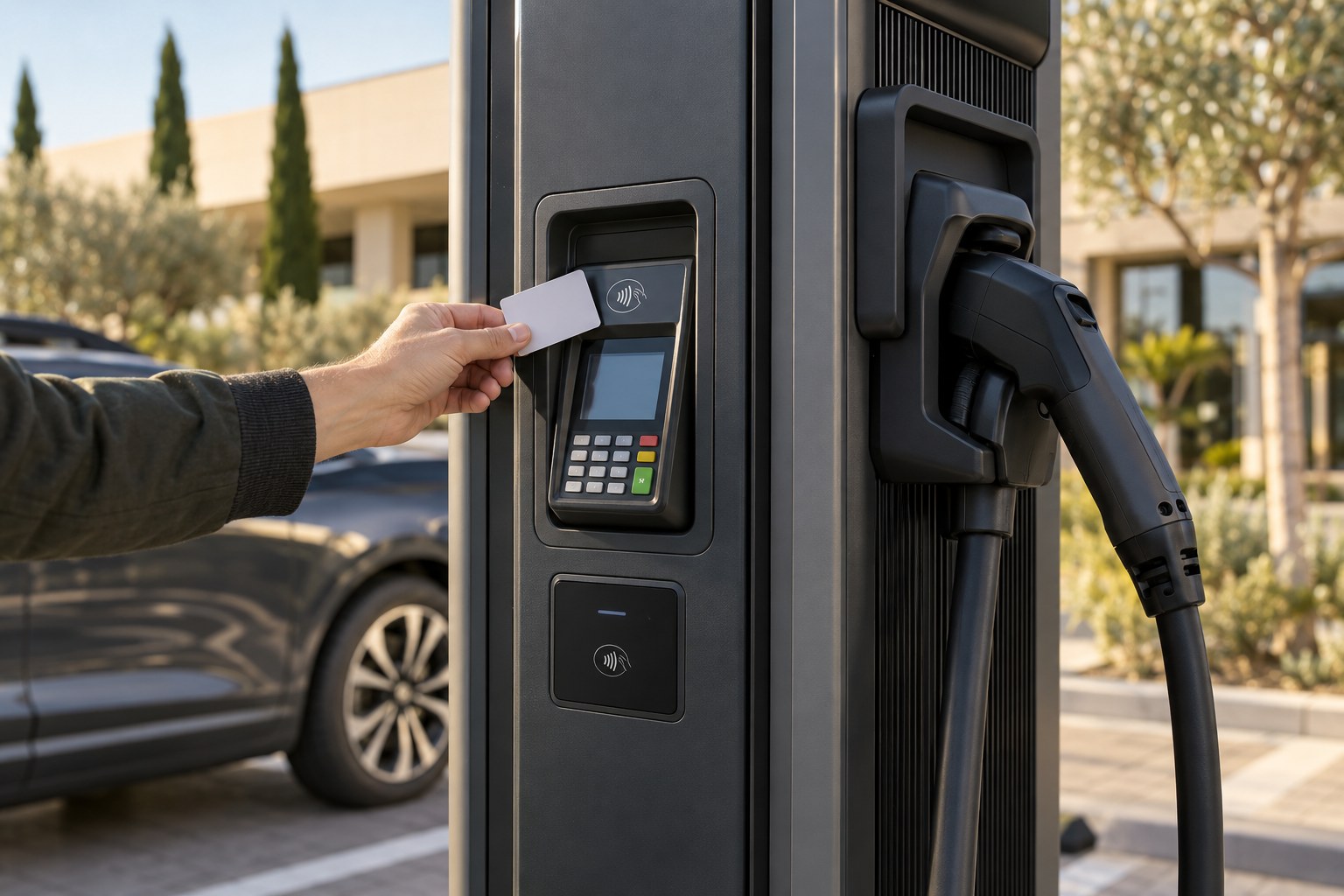
The RFID tags They can authorize authorized individuals or groups. Apps and platforms can offer other methods, if provided by the solution. An access card is not a payment terminal and does not necessarily involve payment.

For fleets and personnel, groups and rules can be defined; for guests and occasional users, a comprehensible path is required. The behavior without connection is also agreed upon: local authorization depends on the functions and settings of the system.

Reserved access or ad hoc payment before the sessionRFID or enabled account identifies reserved access. The ad hoc payment follows the mode provided for the site, possibly POS. Both precede authorization and session; then summary and registration. RFID does not imply payment. TWO PATHWAYS, DIFFERENT FUNCTIONSAccess and paymentReserved accessRFID or accountPayment ad hocPOS or modeplanned on the siteAuthorizationRecharging sessionSummary and registration

States, sessions, reports

From a single point to an overall view.

Illustrative dashboard of charging pointsThe three sessions concluded18+12+20kWh total 50kWh; fleet30, guests20. The points standings are an example view, not live data. ILLUSTRATIVE VIEW · FOUR POINTSThe recharge, at a glance3 sessionsconcluded in the example50 kWhregistered energyPoint 01In charge of chargingPoint 02In stockPoint 03WaitingPoint 04To be verifiedFleet: 30 kWhGuests:20 kWh

A management platform can collect point status, energy delivered, session duration, and reports. The reports help to read usage by location, group, or cost center, according to the functions purchased and configured.

OCPP It is the protocol that allows compatible stations and platforms to communicate. Version, supported profiles, and actual integration are all important factors: the acronym alone does not guarantee any functionality, migration, or service.

A recorded session does not equal an invoice. Internal billing, charges, payments, and accounting documents must be defined separately. Software, connectivity, fees, and support are specified in the proposal.

Illustrative example: three sessions completed with 18, 12 and 20 kWh total 50 kWh; 30 kWh are allocated to the fleet and 20 to the guests. States, codes and energies are synthetic.

The data must serve management purposes: access based on role, necessary information, and appropriate retention periods. The example view uses only synthetic states and codes, without names or tags.

Payment of the recharge

The right service, even for those who only come once.

Contactless payment terminal and RFID reader on charging station

A parking lot reserved for employees and one accessible to customers requires different assessments. The private ownership of the area is not enough to exclude public access.

For paid points accessible to the public, the AFIR rules provide for ad hoc charging and payment methods to be verified according to power, installation date, and configuration. The occasional user must be able to purchase the single charge without a mandatory subscription to the service.

POS and contactless They can be included in the project with compatible terminals, platforms and payment operators. Where permitted, secure web payment can be provided. Prices, any occupancy costs and instructions must be clear before starting. Not all kiosks have these integrated features.

Why uSolar

A project that brings together plant and use.

The required energy, infrastructure and service are defined in the same document, with activities and conditions that are clear in the proposal.

01

We collect the data

Vehicles, routes, stops, users, site consumption and planned developments.

02

We define the project

AC/DC points, power, circuits, lines, protections, measurements and parking layout. We also verify routes, accessibility and restrictions of the location.

03

We configure the service

Accesses, power distribution, compatible integrations, and, when requested, platform and payment. The proposal distinguishes continuous works, devices, and services.

04

We verify and deliver

Functional checks, planned documentation and instructions for use. The terms of assistance and maintenance are agreed upon for the chosen solution.

Frequently asked questions

The answers before choosing.

Counting the vehicles is not enough. Daily energy must be replenished, return and departure times must be consistent, and it must be possible to move the vehicles simultaneously. More points with shared power can be useful, but the need must be within the available hours.

Not always. Real consumption and margins are analyzed. A dynamic management can distribute the charging, but if the energy demand and the stopping times are not compatible with the system, it is necessary to review the power, schedules, or infrastructure.

No. They require compatible connectors and vehicles. The actual power depends also on the vehicle’s demand, the battery conditions, the station and the possible sharing of the capacity. AC and DC are chosen based on usage, not just on the kW displayed on the license plate.

With a suitable platform, groups can be configured and relevant sessions can be consulted. Before the selection, available data, exports, access roles, and the criteria for assigning costs to the centers of cost are defined. Billing and billing requirements require specific verification.

No. It favors communication between systems, but it is necessary to verify the version, the implemented functions, and the compatibility of the chosen combination. The availability of data, credentials, any constraints, and any platform switching conditions must also be clarified.

Yes, with a configuration that provides for it and with the relevant services activated. RFID readers and card readers perform different functions. For public access, there are also ad hoc procedures, price transparency, and applicable requirements.

It depends on the system. Local permissions, already started sessions, data storage, and power management can have different behaviors. We define them in the project and verify the intended configuration, without assuming that all functions remain available.

Let's start with your business

Tell us who is coming. And when they have to leave again.

The number and type of vehicles, the duration of parking, and the available power are a good starting point. Add a floor plan or photos of the parking lot and indicate whether charging will be reserved, open to customers, or accessible to the public.

×