
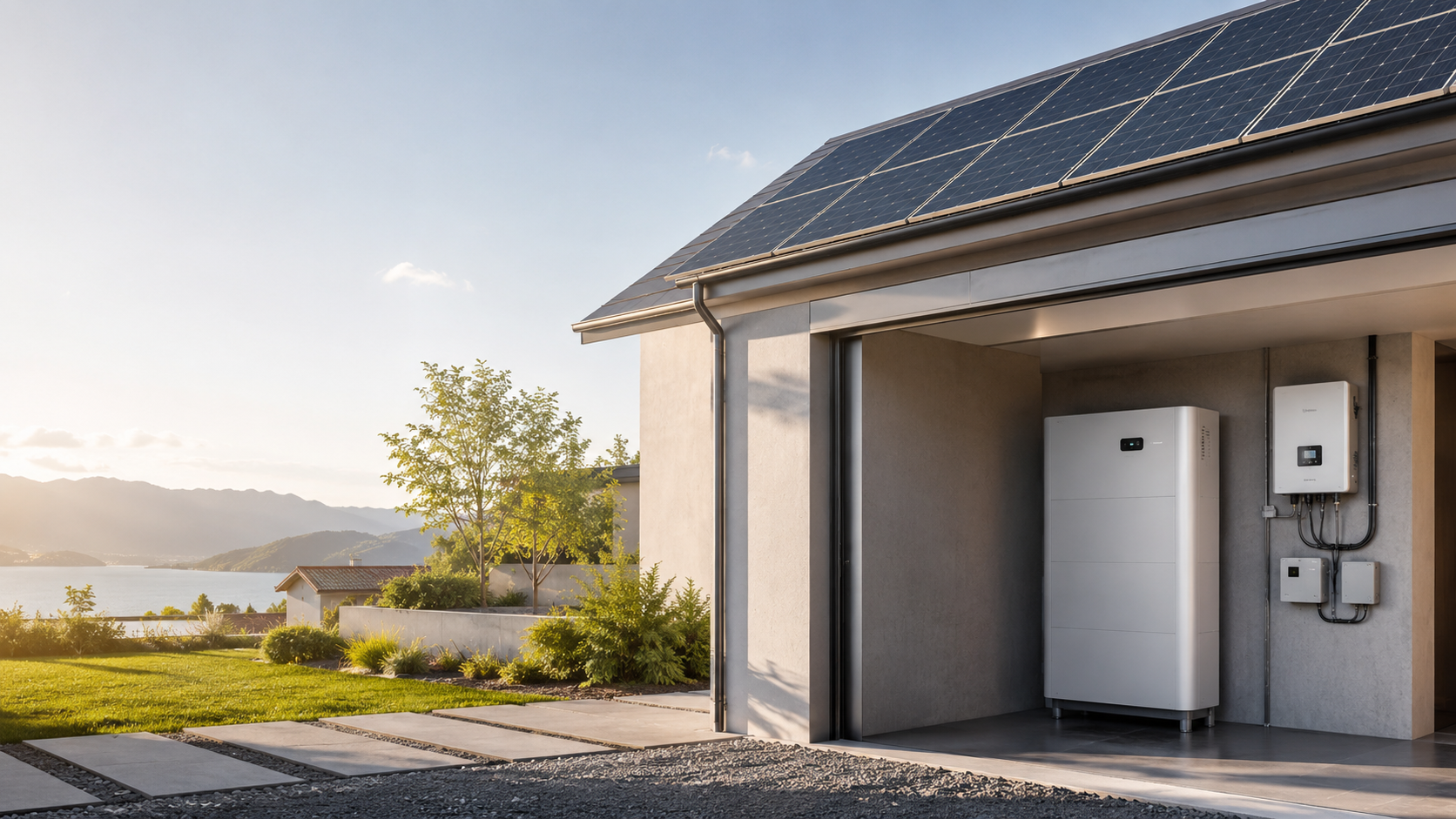
BATTERIES FOR HOUSEHOLD AND APARTMENT USE
Today's sun.
A part of your evening.
A storage battery can help you use more energy than your photovoltaic system can. We choose it based on the available excess, subsequent consumption, and what you really require from the system.
SELF-CONSUMPTION, WITH A DIFFERENT TIME SLOT
The energy is conserved.
The needs are measured.
When photovoltaic panels produce more energy than the home consumes, part of the surplus can be stored in the battery. The available energy is then returned to compatible appliances, for example after sunset.
Accumulation does not produce energy and does not eliminate days with little sunshine. The balance includes conversion losses, charging and discharging limits, and any reserve intended for backup. The grid continues to cover what is missing.
To understand whether it is useful, we compare production, inputs and withdrawals in different seasons. A large battery that is rarely charged could be less suitable than a more compact solution.
TWO NUMBERS, TWO QUESTIONS
How much energy?
And how much power together?
kWh · capacity
It describes how much energy can be stored. In the comparison, the focus is on the actually usable capacity and reserve: the nominal value does not always coincide with the energy available for daily consumption.
kW · the power
It describes how much the system can charge or deliver at a given moment. Inverter, battery, and configuration must support the expected loads; many kWh do not guarantee that everything will be turned on at once.
Two families with the same annual consumption may have different needs. It matters when they are at home, how much they use cooking and air conditioning, and how much production remains available. The choice links energy, power, investment, and usage patterns.
THE FUNCTIONS TO CHOOSE FROM
More self-consumption and backup
They are different objectives.
Do you already have photovoltaic panels?
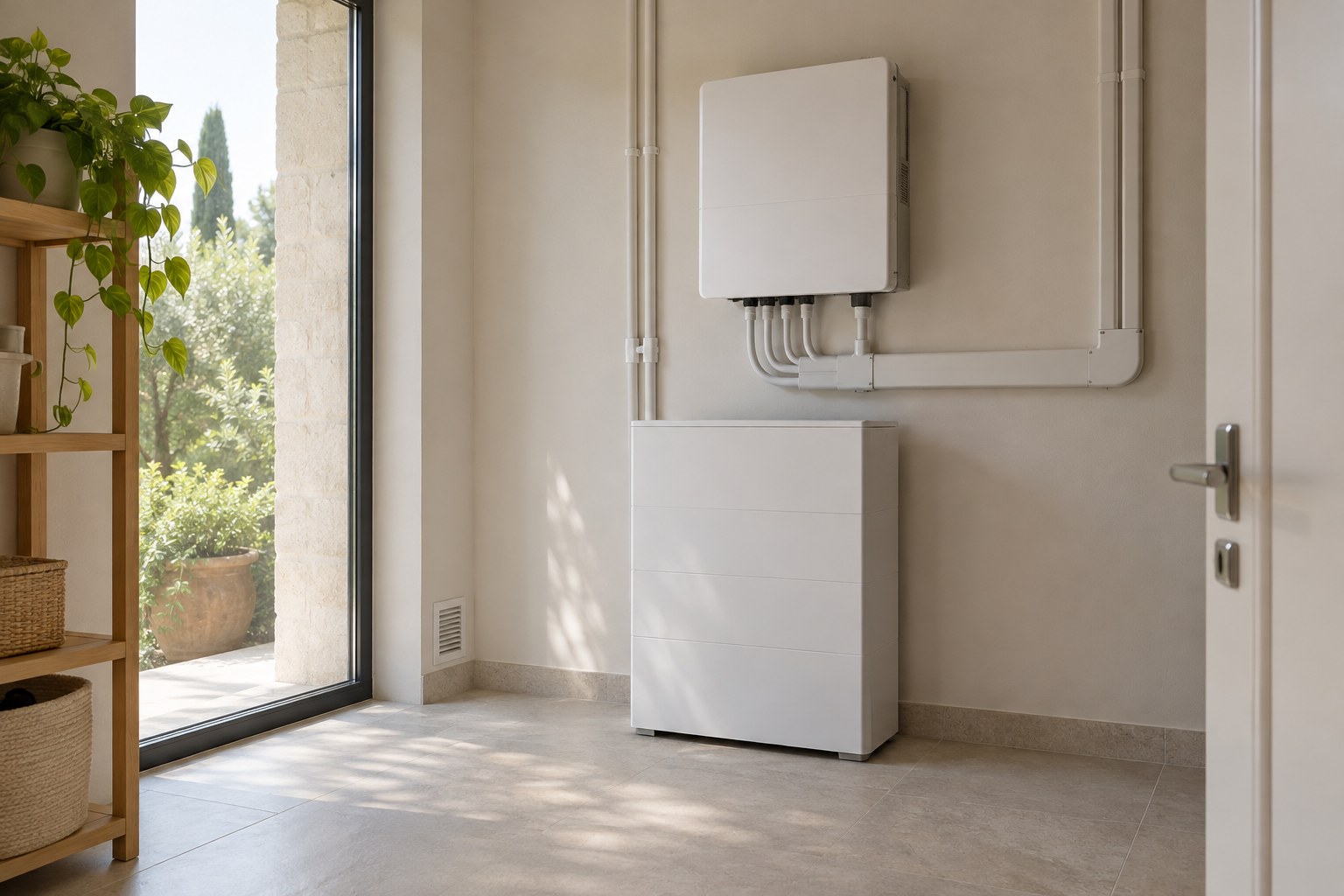
We verify the inverter model, electrical schematic, measurements, and compatibility. Integration may require additional components or a different architecture. Not every battery connects to every inverter; future expansions also have specific requirements.
Do you want energy in a blackout?
A single battery is not enough. A compatible system is needed, with disconnection from the mains and pre-configured circuits. We define the loads to be maintained, power, expected autonomy and transfer times; sensitive devices may require a dedicated UPS.
The emergency reserve occupies a portion of the available energy: what you conserve for an interruption cannot be consumed at the same time for other purposes. The operation of the photovoltaic system during the blackout should also be verified on the system.
In a condominium, the accumulation of water can be studied for the common services. The connection to that utility does not automatically feed the apartments: the scheme, measures, and purpose of the project must be clarified.
THE BALANCE BEFORE THE CUTTING
Conserve energy.
Understanding how much it can return.
Two simple scenarios show why capacity, power, and losses must be considered together. The goal is to choose a configuration consistent with the available energy and subsequent consumption.
CALCULATION SCENARIO · 01
Energy takes a path.
Suppose that 7 kWh of excess energy is sent to the storage and that the overall efficiency of the cycle is 90%. The useful return is 6.3 kWh: the losses are part of the balance, they are not added to the energy output.
CALCULATION SCENARIO · 02
The same energy lasts differently.
In a distinct example, let’s assume 6 kWh already available to loads after losses and reserve. At a constant absorption of 1.5 kW correspond 4 theoretical hours. With variable loads the duration also changes.
Values assumed to explain the calculation, not battery performance. Sufficient charging space and compatible output power are required. The times are not guaranteed backup autonomy: operation without the network requires a dedicated configuration.
From possibilities to concrete project.
HOW WE WORK
From data to configuration.
1. Let’s read the installation
We collect bills, production, input and extracted energy, component models, and habits. If you want a backup, we also identify the priority devices.
2. Compare the options
We assess useful capacity, power, compatibility, losses and seasonal use. The proposal distinguishes components, functions, warranties and included activities, without attributing the same benefit to all the energy loaded.
3. Install and configure
We define the location and connections, implement the planned integration, and set the priorities. Space, environmental conditions, and the manufacturer’s instructions are taken into account in the checks.
4. We verify the usage
We check the operation and guide you through the monitoring process. Support and maintenance are defined according to the agreed solution and service.
FREQUENTLY ASKED QUESTIONS
The answers, before the choice.
Is the battery always worth it?
No. The advantage depends on available surpluses, subsequent consumption, losses, the cost of the intervention, and the conditions of supply. If you already use almost all of your production during the day, accumulation might not be as important.
How many kWh do I need?
The capacity is sized based on the consumption to be covered and the energy actually available for charging. It is not enough to match a number of kWh to the power of the panels: at least production, withdrawals, inputs and seasonal fluctuations are needed.
Can I add it to the existing photovoltaic system?
In many cases, yes, after a verification. The inverter may already be compatible or other components may be needed. Possible architectures, required functions, and modifications to the system are compared.
During a blackout, does the entire house stay lit?
Not automatically. The project establishes which circuits can be powered and with what limits. They take into account the required power, the available energy, compatibility, and switching times. Backup does not always equate to uninterrupted power supply.
How long does it last and can I extend it?
Durability, guarantees and expansion possibilities depend on the product, its use and the conditions specified by the manufacturer. The residual guaranteed capacity, operating limits and compatibility of the additional modules must be taken into account when choosing.
Can it also power a heat pump and a car?
Consideration is given to the current power and the energy required. These loads can absorb a significant portion of the accumulation: priorities and schedules must be consistent with the rest of the house and with any backup reserve.
TO ARRIVE PREPARED
The right questions, calmly.
Add a battery
The checks to be carried out when the photovoltaic system is already installed.
Understanding the backup
What does EPS mean and which utilities can remain supplied?.
THE PROJECT CAN CONTINUE
One house, more possibilities.
Photovoltaic on the roof
Production and accumulation arise from the same energy balance.
LET'S TALK ABOUT YOUR HOUSE
Let’s start with energy
that you can use better.
If you already have photovoltaic panels, prepare the production data and the inverter model. Tell us about your evening consumption and if you also want a backup function.
 Italiano
 English (UK)
 Español
 Deutsch (Sie)
