
Adding a battery to the photovoltaic system: the checks before the quote
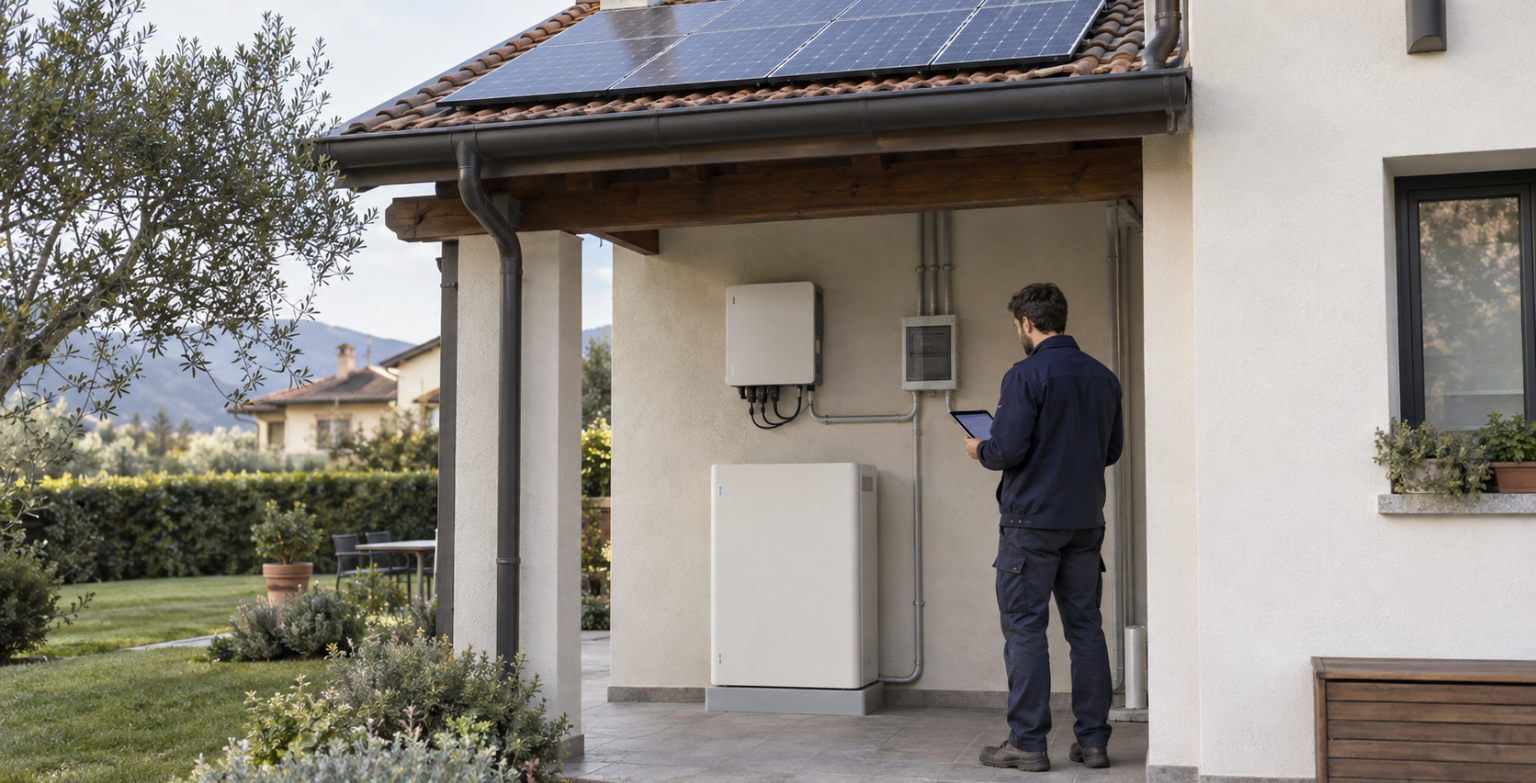
A battery can shift some of the solar energy towards evening, but it does not increase the production of the panels. To add it to an existing system, three things must be checked: the actual available energy, technical compatibility, and the objective of the project. Self-consumption and power supply during a blackout require different assessments.
Published on September 11, 2026
Three points to keep in mind
01
The battery displaces available energy: it does not create new production.
02
Capacity, power and compatibility must be verified separately.
03
Backup requires a specific project and components.
01 / In Depth
Photographing the system that already exists
The starting point is the precise model of the inverter, along with the power of the modules, the year of installation, the electrical wiring diagram, whether it is a single-phase or three-phase supply, and connection documents. Any optimizers, meters, and monitoring data are also useful. The brand name alone does not identify compatibility with a battery.
Before adding a component, the status of the system must also be verified. An anomaly, a meter configured incorrectly, or an inverter near a replacement that is already necessary can change the solution. The proposal must explain which equipment is being maintained and which is being modified.
02 / In Depth
Two technical routes to compare
In the continuous current pairing, a compatible battery works with the hybrid inverter provided by the project. In the alternating current pairing, the storage system uses its own conversion system and is connected to the AC side. This latter architecture can allow the existing photovoltaic inverter to be retained.
There is no one best choice in every situation. Compatibility, conversions, measurements, space, cost of the intervention, and the functions required are all factors to be considered. Even when the components communicate with each other, the power limits and behavior of the entire system remain to be verified.
From day to night: an energy balance
Educational scenario on the AC side: 6 kWh charged, 5.4 kWh returned and 0.6 kWh lost in the cycle; with 6 kWh of evening demand, the remaining draw is 0.6 kWh.
Charged energy
6 kWh
Energy returned
5.4 kWh
Cycle losses
0.6 kWh
AC–AC cycle efficiency assumed: 90%
Available capacity and sufficient power
No additional reserve for blackouts
Hypothetical evening question: 6 kWh
03 / In-depth analysis
Profiles are needed, not just an annual bill
The bill measures the electricity drawn from the grid; it does not include all the household consumption: the solar energy used immediately does not count as a purchase. To assess the accumulation, it is necessary to align production, inputs, and consumption over the same intervals and observe different seasons.
A large battery can remain underutilized if the excess capacity is limited. A small one can run out quickly compared to evening consumption. Before sizing it, it is also worth considering moving some consumption to the sunny hours, when it is practical without inconveniently changing habits.
04 / In Depth
A simple balance sheet, with declared assumptions
Let’s imagine that we send 6 kWh of excess energy measured on the AC side to the accumulation. Assuming, just for this example, an overall cycle efficiency of 90%, they will return to the 5.4 kWh loads. With a nighttime demand of 6 kWh, there will be 0.6 kWh left to be drawn from the grid.
The scenario assumes available capacity and sufficient power, without an additional reserve for the blackout. It does not describe a product or a day of a customer. The actual result changes with losses, temperature, state of charge, operating limits, and consumption patterns.
05 / In-depth
Capacity, power and backup are three checks
kWh describes the energy; kW describes the speed at which it can be charged or delivered. The nominal capacity must be distinguished from the usable capacity. A reserve dedicated to emergencies reduces the available energy for ordinary self-consumption and must be included in the sizing assumptions.
To operate in the absence of mains power, devices and backup configuration, electrical separation and defined circuits are required. Continuous power, spikes, fed phases and transfer times must be checked. A battery installed for self-consumption does not automatically become an UPS.
06 / In Depth
Close the project before the order
The assessment includes the installation location, the environment approved by the manufacturer, accessibility, protections, and documentation. For incentive-based systems or systems with GSE services, the applicable procedures and connection requirements must be verified. It is not enough to add a device to the app.
In the quote, ask for model, usable capacity, power, components included, active functions, and warranties. A reliable economic comparison considers recoverable energy, losses, and conditions of purchase and sale. Self-consumption means using a larger portion of one’s own production; self-sufficiency indicates how much of the consumption is covered: it is not the same percentage.
The most frequently asked questions
Not always. A paired accumulation in AC can maintain the existing one; other configurations require a compatible hybrid inverter.
It is not an automatic result. Seasonal production, consumption, capacity, power and losses determine how much energy remains to be purchased.
Given the same amount of usable energy and load, yes; however, the power, reserve, and system limits must also be respected. The nominal capacity is not enough to estimate it.
 Italiano
 English (UK)
 Español
 Deutsch (Sie)
