
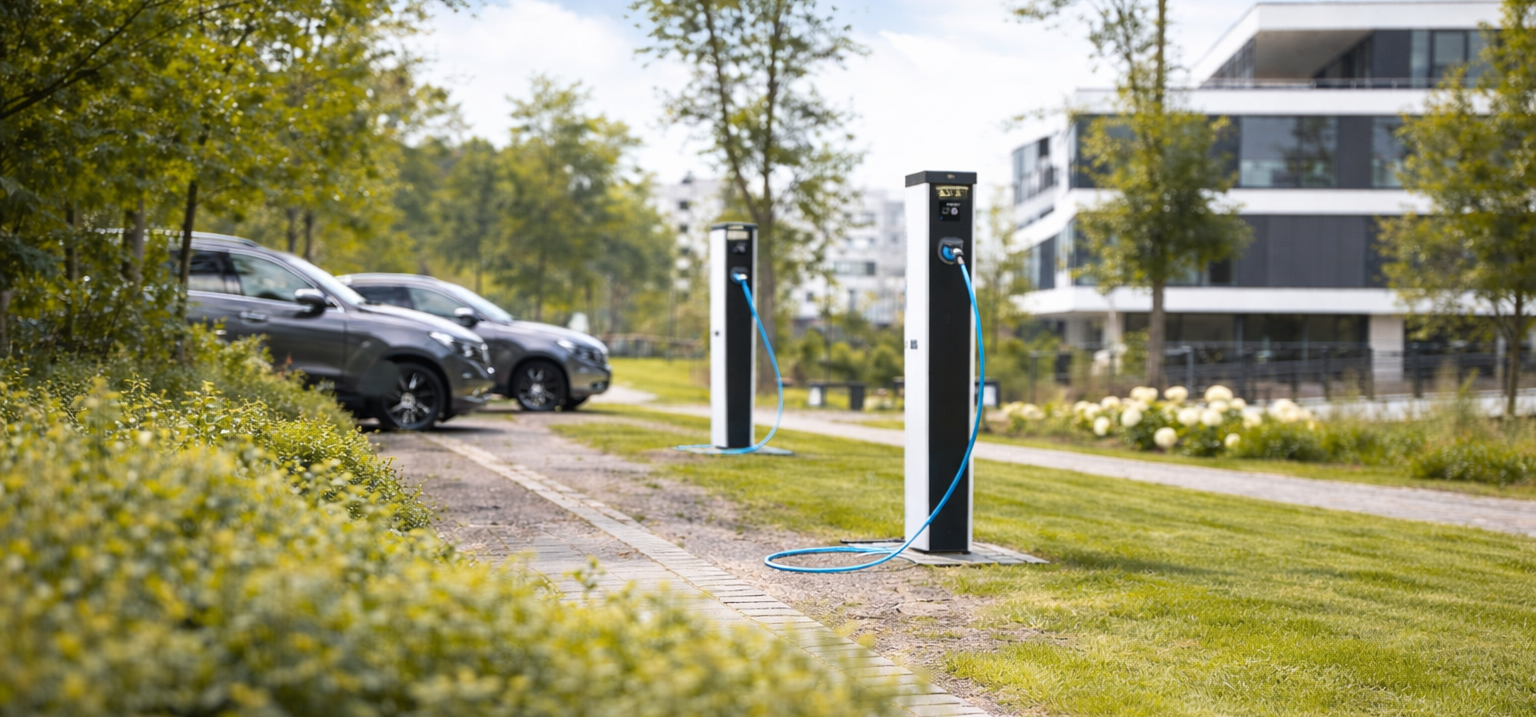
ELECTRIC RECHARGE FOR HOME AND COMPLEX
Your car stops.
The charging is being organized.
We design and install wallboxes and electric charging columns for homes and apartment buildings, starting from the vehicle, the parking times, and the available power. To get you started with a solution suited to your use.
EVERY PARKING LOT HAS ITS OWN REQUIREMENTS
Where do you want to start?
01 / THE DAILY LIFE
At home
The car model, the usual mileage and the hours it remains parked help define the charging process. We assess the meter, other consumption and the route from the car to the parking space.
02 / SHARED SPACES
In a condominium
Parking spaces, electricity usage, cable routing and access management are clarified. For shared areas, usage and measurement criteria must be consistent with the condominium organization.
THE NUMBER ON THE COLUMN IS NOT ENOUGH
Charging has more than one limit.

The actual power depends on the station, the system, the available power supply and the vehicle. In AC charging, the onboard charger also counts: a car does not automatically use all the nominal power of the wallbox.
Monofase and three-phase require specific checks. Before choosing a size or increasing the contractual power, we compare the vehicle's needs with the hours of downtime and the consumption that may be running simultaneously.
The kW indicates the charging power; the kWh indicates the energy to be replenished in the battery. The time depends on both, as well as on losses and operating conditions: an estimate must state these assumptions.
HOUSE AND CAR, IN THE SAME BALANCE SHEET
Power follows
What is happening.
With compatible devices and an appropriate measurement, dynamic management can adapt the charging to the remaining power available. If other consumption increases, the wallbox can reduce the absorption; when the margin becomes available, it can increase it.
This function requires proper measurement, communication, and configuration. It does not replace the sizing of cables and protections, and it does not provide a power that the system cannot provide.
At multiple charging points, the power can be distributed according to the supported functions and the agreed priorities. It is necessary to distinguish the sharing between the charging stations from the control of the total collection of the condominium.
WHEN THERE IS EVEN THE SUN
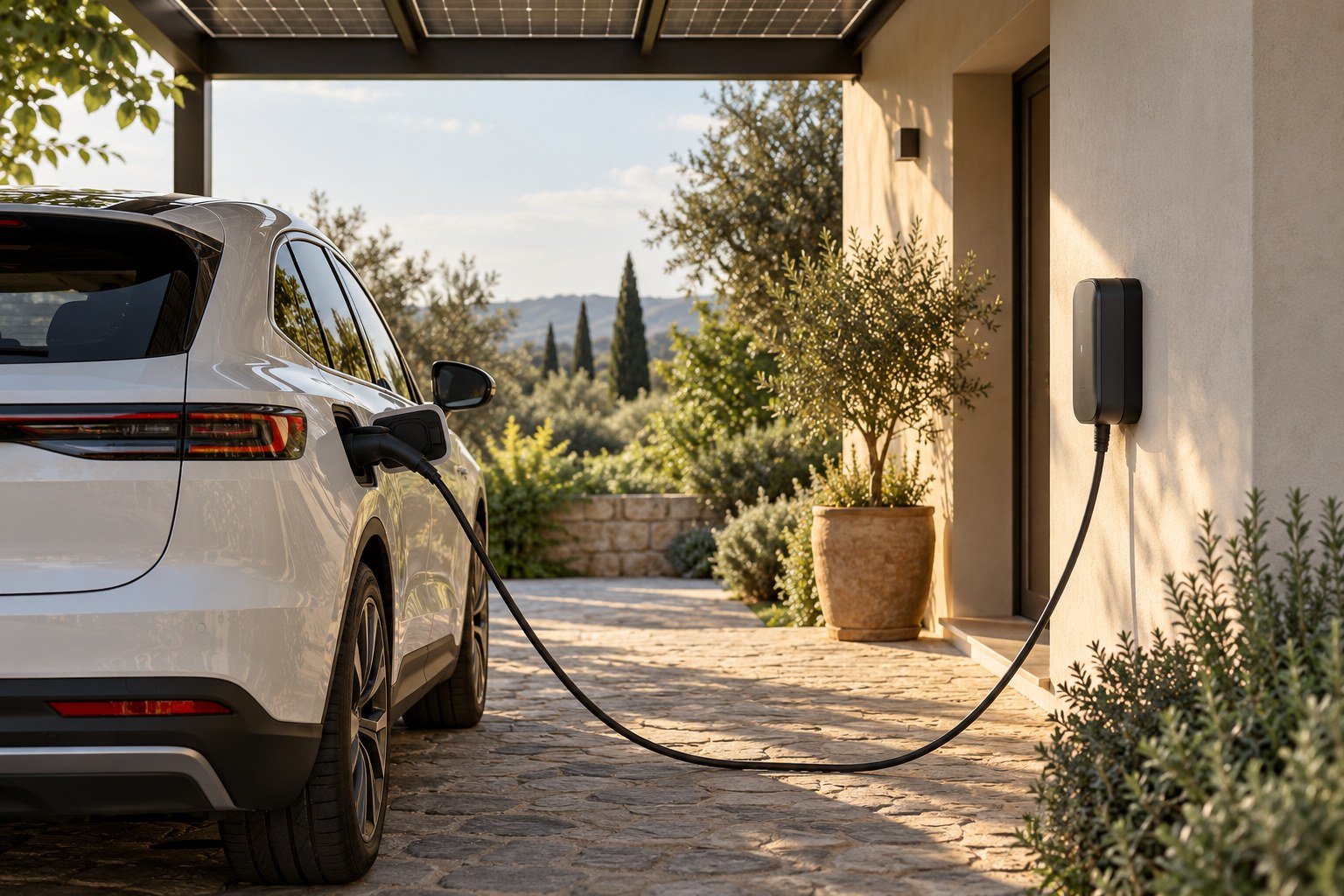
A coordinated recharge
with photovoltaic energy.
The car is parked during the day
The available production can contribute to recharging. The priority to the surplus requires a compatible solution, correct measures and operating thresholds; with little sunshine, it may require grid integration or longer times.
The car returns in the evening
The home’s programming, supply, and consumption are evaluated. A home battery can contribute within its limits, but charging the car competes with other uses and with any backup reserve.
The choices are linked to the project of the photovoltaic production and of the’Domestic accumulation. You don't need to install everything together to start thinking about integrations.
THE CAR IN YOUR DAY
How much time do you have?
How much power can you dedicate?
Imagine returning with 20 kWh to recharge. Before the power written on the wallbox, let's look at the hours of downtime and what's already working at home.
CALCULATION SCENARIO · 01
Time is born from two numbers.
The values only show the energy/power ratio. These are calculations without losses or reductions in power: in reality, the onboard charger, power supply, temperature, and the behavior of the vehicle also count.
CALCULATION SCENARIO · 02
The house and the car coordinate with each other.
With a hypothetical threshold of 6 kW, if the house increases from 2 to 4 kW, the car’s margin drops from 4 to 2 kW. A compatible controller can adjust the charging, instead of always requiring the same power.
The power values are assumptions, not settings to be applied to your system. Thresholds, margins, phase limits, and minimum charging power occur on the system. If the necessary margin is not available, charging may have to slow down or stop.
From possibilities to concrete project.
WHAT WE DO
From the choice of the point
at the first charge.
1. Analysis of usage
We collect vehicle data, driving patterns, stop times, and the users to serve. We identify parking constraints and possible future needs.
2. Verification and design
We assess the power supply, panels, cable route and protections. The proposal distinguishes the device, the planned works, the control functions and the relevant documentation activities.
3. Installation and configuration
We set up the charging point and configure the agreed functions: power limits, access controls, and compatible integrations. Any additional works are clarified in the proposal.
4. Inspections and delivery
We check the operation, deliver the required documentation, and explain how to use it. Support, connectivity, and additional services depend on the chosen solution and the agreed conditions.
FREQUENTLY ASKED QUESTIONS
The answers, before the choice.
Should I increase the power of the counter?
Not always. It depends on the energy to be replenished, the rest periods, and other consumption. Dynamic management can help to use the available margin, but it does not replace verification of the supply and the system.
A more powerful wallbox charging faster and faster?
No. In alternating current charging, the vehicle has its own limit, which is also linked to the on-board charger. The actual power is limited by the entire chain: power supply, installation, wallbox and car.
Can I only use photovoltaic energy?
With a compatible configuration, it is possible to prioritize the available surplus. Production must reach the necessary thresholds, and the car must be connected. It is determined whether to wait for the sun or also allow energy from the grid.
Can I install it in my apartment building’s storage room?
The assessment starts with the availability of parking spaces, the supply of electricity and the route of the connections. The technical aspects, interference with common parts and the relevant administrative procedures must be clarified before installation.
How do you manage multiple users or vehicles?
Accesses, session measurement, and power distribution depend on the device and platform. In the project, we distinguish between private points and shared points within the condominium, indicating the intended functions and the usage criteria to be agreed upon.
What is needed for a quote?
Indicates car model, usual mileage, parking times and address. Useful information includes power supply capacity, photos of the panel and parking area, indicative distance from the connection point and information about existing photovoltaic or storage systems.
ENERGY AND MOBILITY
The charging point
It is part of the system.
The quality of the project is also evident in the choices that precede the device: useful power, connections, required functions, and future possibilities. In our case, the device is designed to be used in a wide range of applications. guide to the first comparison of the energy system We explain why house data comes before component data. If an accumulation is planned, delve deeper the compatibility checks.
LET'S TALK ABOUT YOUR HOUSE
Let’s start with the car.
And where do you park it from?.
House or condominium unit: tell us which vehicles you want to charge, when they remain parked and which electrical system is already available.
 Italiano
 English (UK)
 Español
 Deutsch (Sie)
