
Photovoltaic energy and household consumption: how much energy do you really use?
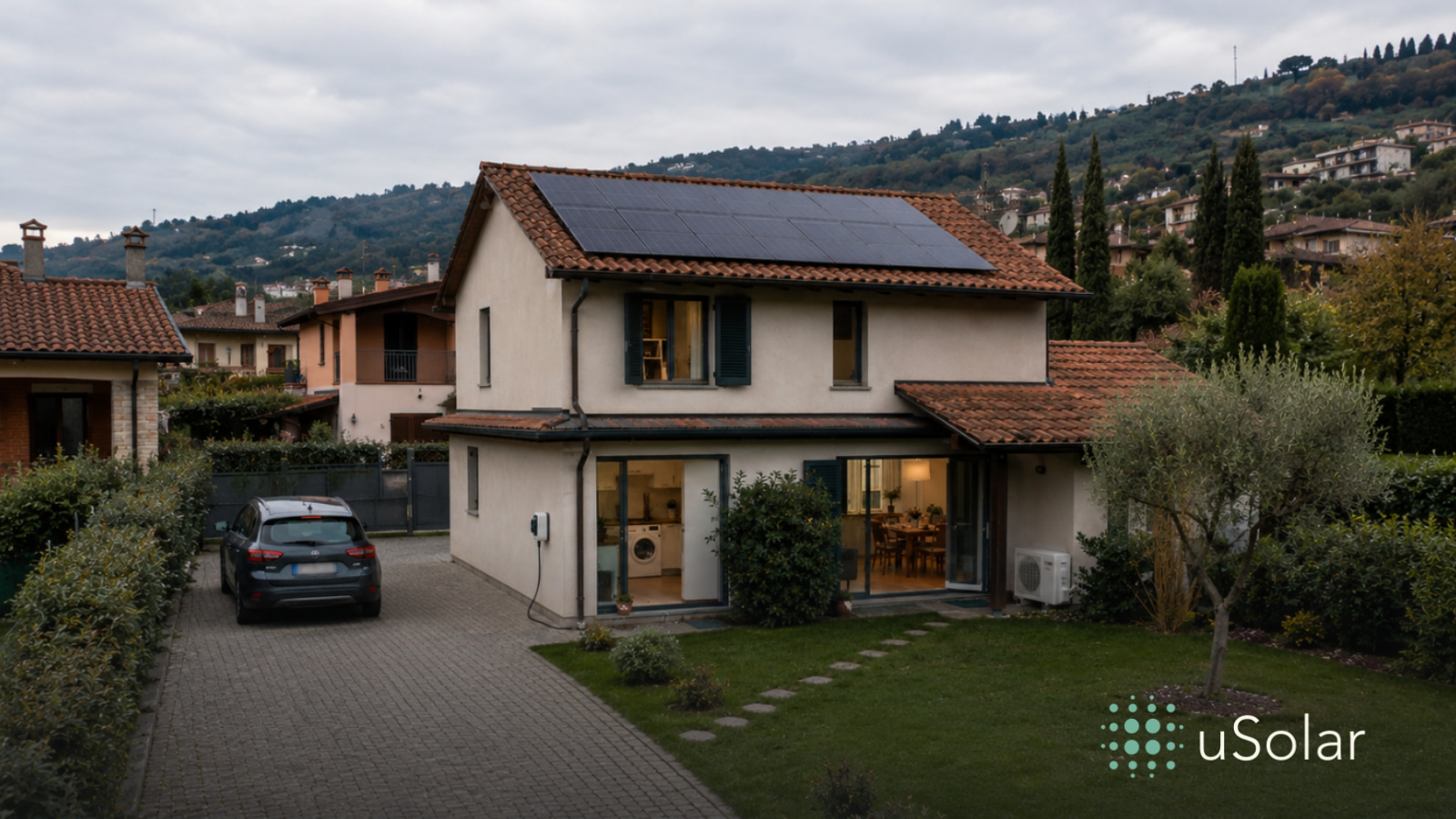
Photovoltaics and household consumption must be considered together. Knowing the annual production is important, but the result also depends on the energy you manage to use while it is being produced and the energy you continue to draw from the grid.
Published on August 3, 2026
Three points to keep in mind
01
The net consumption is not always the total consumption of the house.
02
Self-consumption and self-sufficiency are different indicators.
03
Programming and energy storage require available energy and power.
01 / In Depth
It starts with consumption, but also monitors schedules
The annual sum of the bills is a first reference. However, to size a solution, it is necessary to understand how consumption is distributed: weekdays and weekends, summer and winter, central hours and evening hours. A house does not necessarily have the same profile every day.
The Consumption Portal allows you to consult the historical data available for your supply. Where available, the time detail makes the comparison more concrete. For an already active system, it should be remembered that the electricity drawn from the grid does not correspond to all consumption: part of it may already be covered by the photovoltaic system.
02 / In Depth
Self-consumption and self-sufficiency answer to different questions
Self-consumption indicates how much of the photovoltaic energy is used on-site. Self-sufficiency, on the other hand, describes how much of the demand is covered by local production. The two percentages have different denominators and cannot be exchanged in offers or in the app's screens.
In the presence of energy storage, the criteria used by the monitoring system must also be clarified, because recharge, discharge, and losses can be represented in different ways. A correct comparison requires the same temporal interval and consistent measurement limits.
Two percentages, two questions
Battery-less scenario: 20 kWh production, 16 kWh consumption, direct use 8 kWh.
Production
20 kWh
Consumption
16 kWh
Direct use
8 kWh
Self-consumption
8 / 20 = 40%
Self-sufficiency
8 / 16 = 50%
A hypothetical single day, the electrical boundary of the house.
03 / In-depth analysis
An example with numbers that can be checked
Imagine a day without batteries: the photovoltaic system produces 20 kWh, the house consumes 16 kWh, and 8 kWh are used directly during production. The remaining 12 kWh are fed into the grid; to meet the household needs, 8 kWh are drawn from the grid.
Self-consumption is therefore 8 out of 20, equal to 40%; self-sufficiency is 8 out of 16, equal to 50%. These numbers are just an example of calculation. They do not describe a real family and do not allow one to derive economic savings on their own.
04 / In Depth
Moving a load makes sense when it remains useful
A washing machine, dishwasher, or car charging can sometimes be programmed to run at more favorable times. The choice must respect the needs of the home, the instructions for the appliances, and the available power. Turning everything on at the same time can increase the load instead of eliminating it.
It is more useful to observe the residual power at the scheduled time than to rely solely on the presence of the sun. The refrigerator, air conditioner, and other loads continue to use energy as a new device is added.
05 / In-depth
When to assess the energy storage
A battery can transfer part of the energy available from the production hours to subsequent ones. Before choosing it, it is advisable to estimate the actually rechargeable surplus, subsequent consumption, power demand, and constraints of the existing system.
The starting point remains the energy profile, not the largest capacity in the catalog. A well-motivated proposal should show the assumptions and explain which consumption remains covered by the grid in different seasons. This makes both the configuration and its daily use more understandable.
The most frequently asked questions
It is not used directly in the home; its eventual valorization follows the applicable contractual relationship and must be distinguished from the avoided levy.
Only if the measurement system is configured to measure them correctly. The inverter’s reading normally measures the output.
It is insufficient to properly assess the temporal coincidence and the utility of the energy storage.

 Italiano
 English (UK)
 Español
 Deutsch (Sie)
