
Photovoltaics for companies: from the production site to the energy project
A corporate facility must fit into the way the company operates. Roofs, land, parking lots, storage and charging offer different possibilities: the project identifies what is really needed and how to connect it to consumption, infrastructure and objectives.
Published on April 3, 2026
Three points to keep in mind
01
Evaluate the site and the consumption before reaching the maximum power.
02
Integrate only functions that have a measurable objective.
03
Ask for an economic comparison with explicit assumptions.
01 / In Depth
How energy reaches the activity
The modules convert light into electric energy in direct current; the inverters convert it into alternating current that can be used by the on-site system. In the ordinary configuration connected to the utility grid, the production contributes to the simultaneous loads and the excess can be fed into the grid within the prescribed limits.
When production is insufficient, the grid continues to provide energy. A storage system can modify its distribution over time, but it does not generate additional energy. Even a domestic system requires customized design: in industry, size, loads, connection, and the complexity of the context change primarily.
02 / In Depth
The roof, ground and carport meet different requirements
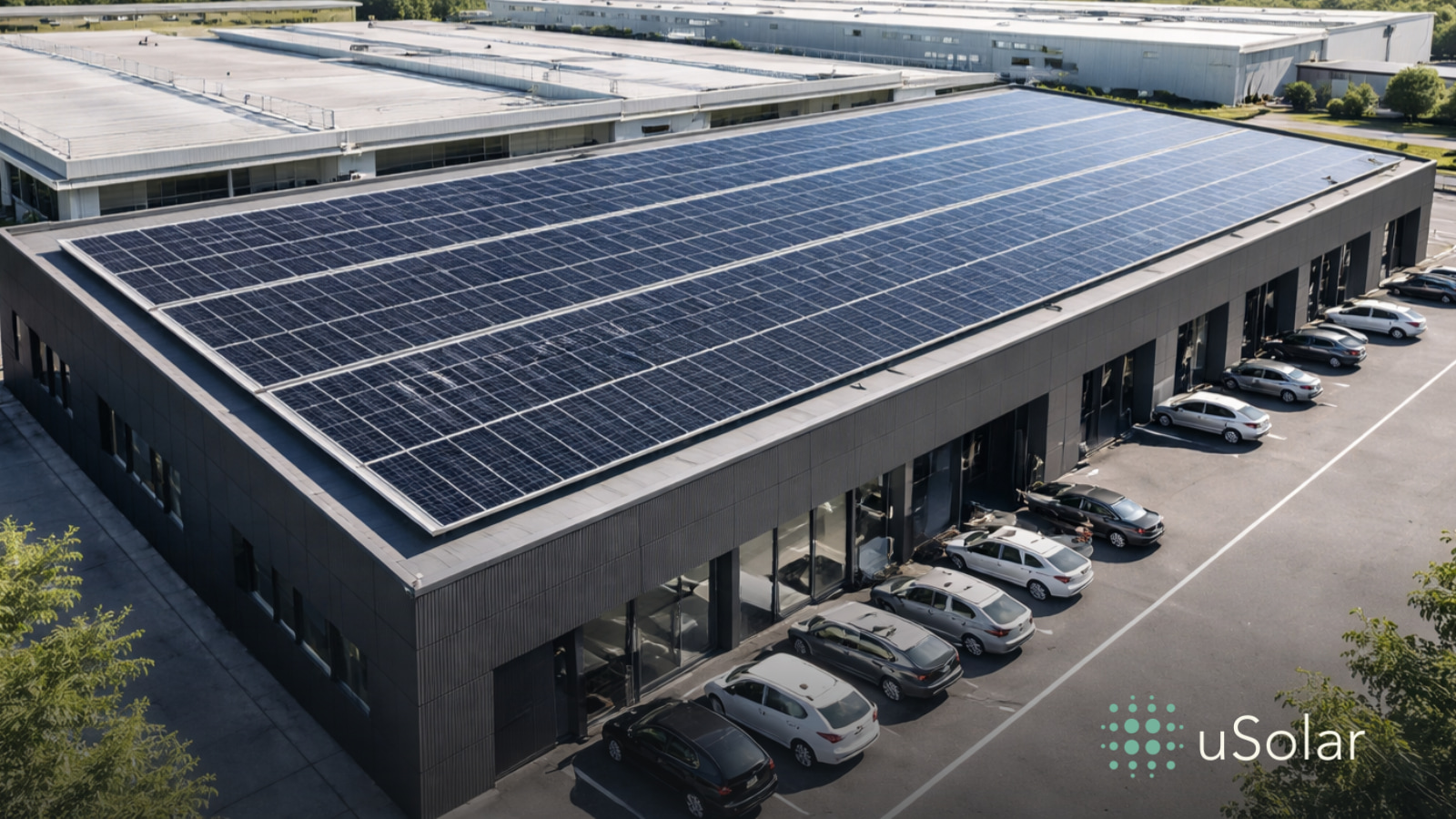
The roof may use a surface already occupied by the building. First, structural, roofing, access, interference, and applicable fire safety assessments must be carried out. If renovations are necessary, it is advisable to coordinate timing and work with the photovoltaic system.
A ground-mounted system requires verification of the availability and suitability of the area, the permitting route, and the connection: an open plot of land is not automatically usable. The carport integrates production and parking, but must comply with road conditions, heights, structures, and usability. The three solutions can be alternatives or parts of the same plan.
From analysis to plant management
A common path that runs through the roof, the ground, and the carport, with additions chosen based on the use.
01
Measuring needs
02
Check the website
03
Comparing the scenarios
04
Design and implementation
05
Monitor and maintain
Project path, not contractual timeline.
Energy storage and recharge are evaluated where appropriate.
03 / In-depth analysis
Cost-effectiveness depends on site data
Representative consumption data, load curves, shifts and opening schedule are required. These are complemented by simulated production, available surface area, connection conditions and future investments actually planned.
The economic model must separate missing purchases, revenue from entry, operating costs, and investment. It is useful to compare multiple sizes and price scenarios, avoiding an identical payback time for each enterprise. Incentives and subsidies should be evaluated based on the specific measure, its availability, and the beneficiary’s requirements.
04 / In Depth
Energy storage and recharging become part of the management process
A BESS can shift energy towards subsequent loads and, if properly sized, help to contain spikes. Useful energy, power, and peak duration and cycle times determine the service obtainable. Continuity functions require an explicitly designed backup configuration.
For electric charging, users, charging times, and available power are all factors to consider. AC and DC respond to different needs; session management, identification, allocation, and payment are functions that can be chosen based on usage. Coordination of loads can prevent charging from being sized without considering production and other utilities.
05 / In-depth
Measuring and maintaining the result over time
Monitoring must allow for the distinction between production, consumption, inputs and alarms, with clear responsibilities regarding the reading of the data. The availability of an app does not equate to a continuous monitoring service: content and frequency of assistance must be defined.
For existing systems, maintenance, revamping, and repowering address different issues. This begins with diagnosis and documentation, evaluating technical constraints, connections, and any incentive relationships that may exist. Replacing components alone does not guarantee an increase in production or greater usable power.
06 / In Depth
A project that the management can evaluate
The proposal should make it possible to read the configuration, phases, works included, exclusions, checks and assumptions regarding the outcome. It should also indicate how to manage access to the site and interference with the activity, without promising a total absence of stops in a general way.
In uSolar, the process links the system to the site and to the company’s programs. The first useful step is to share bills, load data, and information about the spaces. From here, you can choose a system that is proportionate, designed to evolve, and understandable even for those who must approve the investment.
The most frequently asked questions
This is one of the configurations to compare. Self-consumption, inputs, connection, and overall cost can suggest a different size.
No. Operation without a network requires a specific solution, compatible and designed to handle the loads to be supported.
Yes. It is necessary to verify the condition, documents, components, and constraints before deciding on maintenance, expansion, or replacements.

 Italiano
 English (UK)
 Español
 Deutsch (Sie)
