
In-depth information / Companies
A new machine on the way: how the photovoltaic project is changing
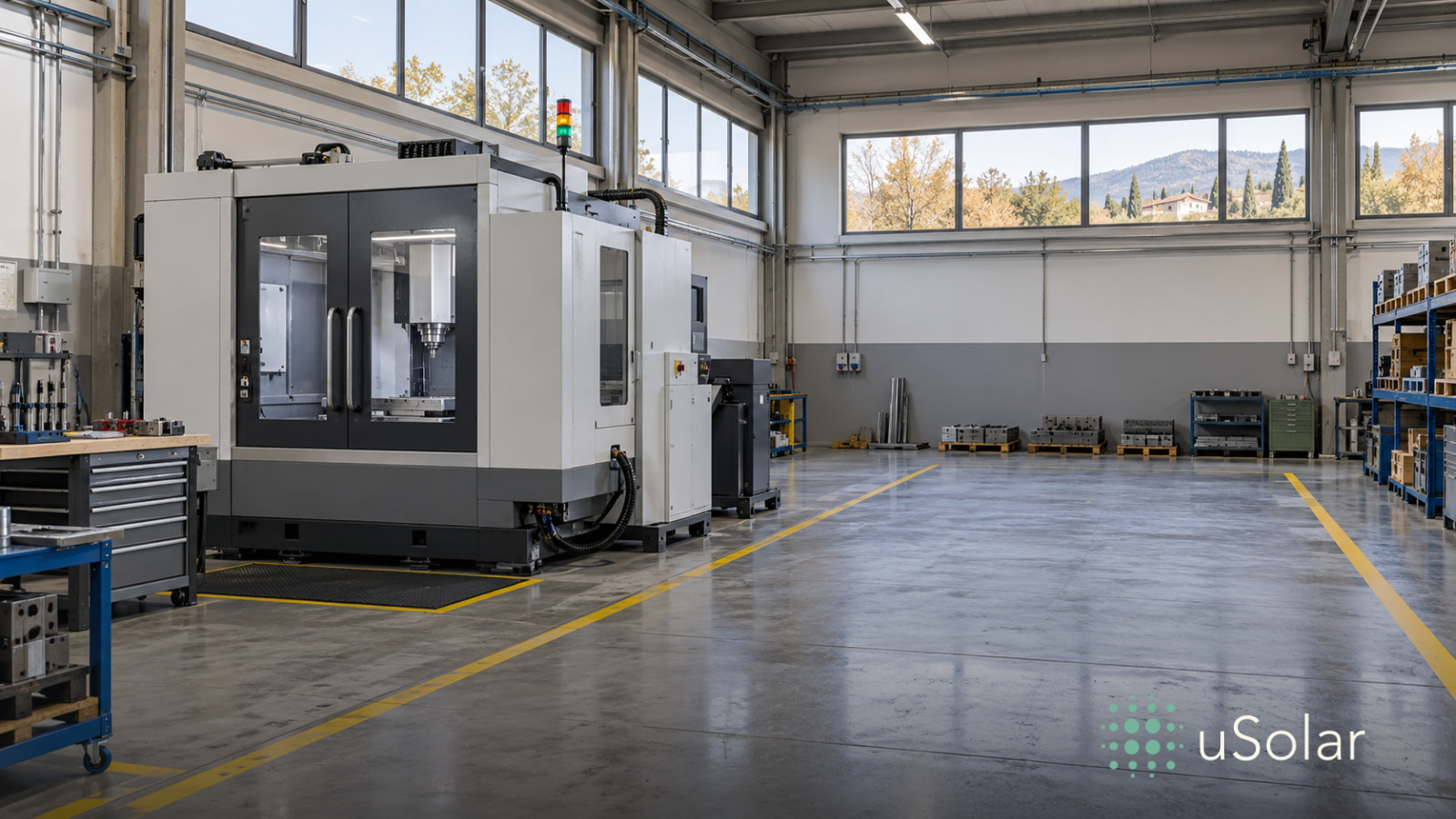
The company is purchasing a new machine, but the electricity bills still reflect the production department as it was before. Designing the photovoltaic system means distinguishing between current consumption, the changes expected from an investment already planned, and assumptions about the future. Mixing these three categories can lead to an unsuitable choice.
9 November 2026 · uSolar
The bills describe the present, not the new department
One year of bills helps reconstruct consumption patterns, but the annual total does not show when machines are working. It is advisable to combine the available data on supply with data on shifts, downtime, holidays, and changes in production. A week with the department closed does not necessarily represent normal operation.
The Portale Consumi portal described by ARERA allows the supply account holder to consult historical consumption data and supply information, with intervals as short as 15 minutes where available. If the consumption of one production line needs to be separated from the rest of the plant, dedicated metering should be assessed.
From the machine's specifications to its actual use
The new purchase requires the manufacturer's documentation and an operating schedule: power demand during each operating stage, start-ups, standby periods, cycle durations and operating hours. The machine's rated power should not simply be multiplied by all the hours the business is open. Any extraction, cooling or compressed-air systems it requires must also be included in the analysis.
It is also necessary to establish whether the machine replaces existing equipment or adds production capacity. In the first case, the comparison must also account for the load that will be removed. In the second, check how its operation overlaps with other departments, rather than considering only the increase in annual kWh.
Three scenarios, with varying degrees of certainty
The first scenario describes current operations using representative data. The second adds the machine already planned, stating the assumed power demand, shifts and expected commissioning date. The third explores developments that remain uncertain, such as an additional shift or a second production line: it is used to compare alternatives without treating that consumption as confirmed.
The graph shows an illustrative example: the base load is supplemented by 8 kW for four hours in the planned project and for six hours in the extended scenario. The increments are 32 and 48 kWh per day, respectively. These are illustrative assumptions, not customer data or indications regarding the size of the photovoltaic system.
The data, in plain language
Current consumption, planned new machine, uncertain expansion
Three operating scenarios on the same scale: current operations, a planned new machine and a possible extension of operating hours that remains uncertain.
Current activities
Comparison base
Planned new machine
+32 kWh per day
Extended use still uncertain
+48 kWh per day
Hours of the day · Same scale in all three panels. Dashed line = use that remains uncertain.
Original teaching example: hypothetical values, not customer measurements or product specifications.
The machine adds 8 kW for four or six hours: 32 or 48 kWh per day, respectively. Each step covers two hours.
The graph does not estimate photovoltaic production, savings or the size of the plant; it does not represent the start-up peaks.
The commissioning date matters too
If the photovoltaic system is commissioned before the machine, there will be an initial period with consumption different from normal operation. The simulation should show this phase and also account for a possible delay in the machine's commissioning. A future benefit cannot automatically be attributed to every month of the first year.
Solar generation must then be estimated for the installation site and compared with the times when the loads operate. The JRC describes PVGIS as a tool for estimating average monthly and annual generation using climate data covering several years. This estimate does not guarantee that the new machine will directly use all the energy produced.
Comparing an immediate choice with a step-by-step process
An assessment can compare a system suited to current operations, a solution sized for the planned change, and a phased approach with possible later expansion. Each alternative should use the same criteria: energy consumed on site, exports to and imports from the grid, investment and the works included. Uncertain developments must remain clearly identified.
The feasibility of expansion must be checked: available roof space, switchboards, cable routes, components and the grid connection can all impose constraints. Battery storage also needs a specific purpose; it does not automatically make up for a system designed around overly optimistic assumptions about future consumption.
The dossier to be prepared before the quote
For the initial discussion, useful information includes electricity bills and available load profiles, shift schedules, the new machine's data sheet, planned production processes and commissioning dates. Identify any equipment that will be decommissioned and distinguish decisions already made from options still under consideration.
The expected result is a clear comparison of scenarios, stating the assumptions, checks still required and the consequences of changes to the plans. After commissioning, measured consumption can be used to compare actual operation with the forecast.
The most useful questions
Is it enough to have the kW written on the machine?
No. You need the power demand and duration of each operating stage, together with auxiliary loads and information about which loads operate at the same time.
Is it worth waiting for the machinery to be installed?
Not necessarily. It can be designed based on documented assumptions, verifying how the results change if the usage or startup differ from the program.
Is it always possible to expand photovoltaic systems later?
This must be checked for the specific project: the roof, components, electrical infrastructure and grid connection may impose limits.
The company's plans also shape the project
Are you purchasing a new machine? Contact uSolar with your available consumption data, the machine's specifications and the expected timescale, so the photovoltaic project can be assessed alongside the development of your business.
Let's discuss your business's photovoltaic project ↗Sources and criteria
Sources consulted on October 29, 2026. The educational hypotheses are separate from the observed data and do not represent a forecast for a specific plant.

 Italiano
 English (UK)
 Español
 Deutsch (Sie)
