
Industrial roof to be renovated: designing together the roof and photovoltaic system
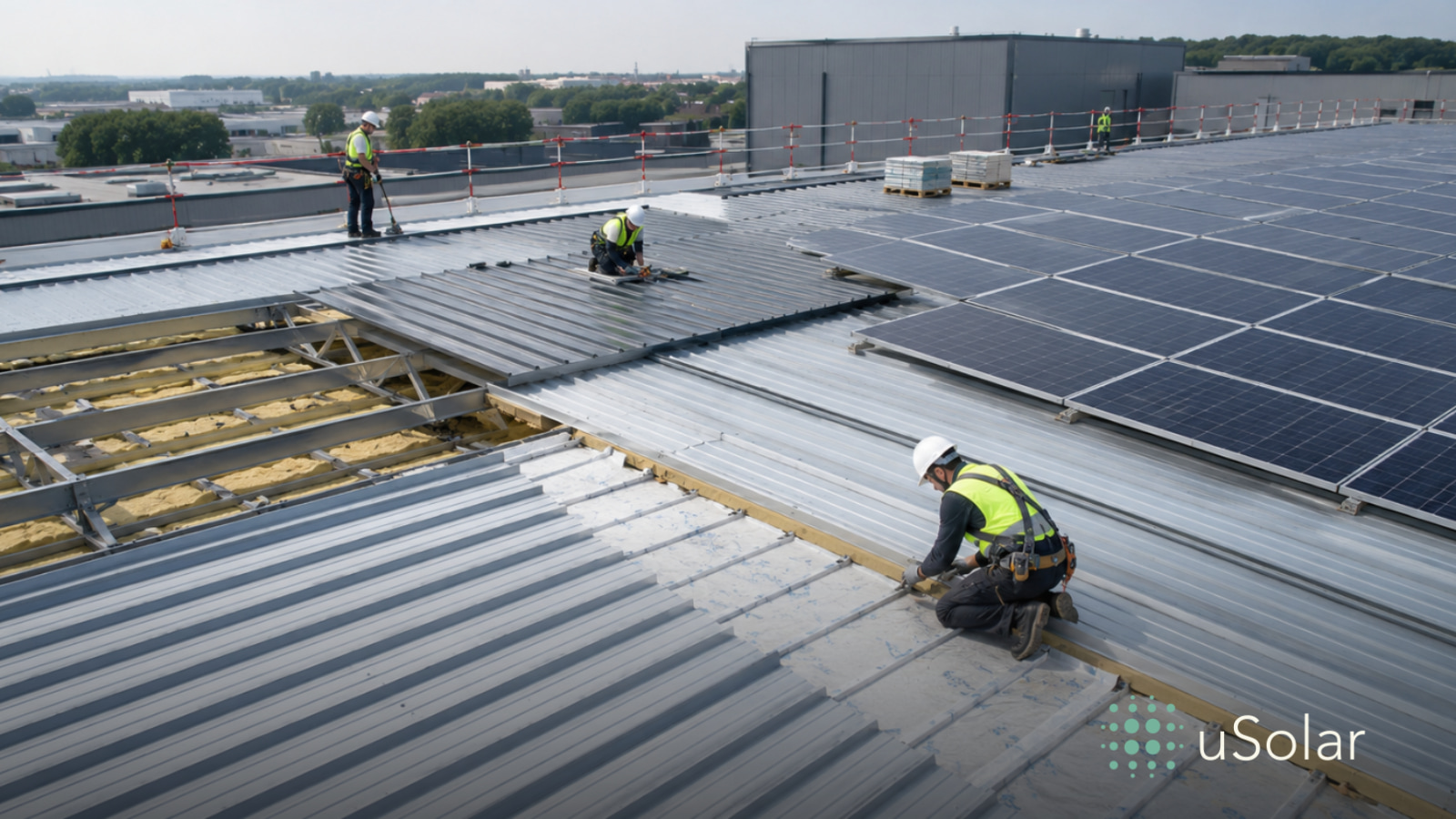
When an industrial roof needs to be renovated, photovoltaic technology should be considered before choosing a new roofing package. Structure, water resistance, insulation, safety and fixing systems must become coherent parts of the same project.
Published on June 19, 2026
Three points to keep in mind
01
Design photovoltaic covers and fixings together.
02
Distinguish structure, durability, insulation and fire performance.
03
Clarify phases and interferences before ordering materials.
01 / In Depth
Identifying the problem before the material
Infiltrations, corrosion, deformations, and insufficient insulation do not necessarily require the same intervention. The initial assessment must distinguish the external coating from the structure and the other layers: replacing what is visible does not automatically solve what is happening underneath.
Available documents, the condition of the surfaces, unique points and accessibility help define the details. If a photovoltaic system already exists, disassembly, storage, inspections and possible reinstallation must also be considered, avoiding treating them as marginal activities added at the end of the budget.
02 / In Depth
Photovoltaic power generation introduces specific requirements
The mounting solution must transfer the actions to the intended structure and maintain the performance of the cover. Loads, wind, fixings, cable runs and maintenance require coordinated assessment. There is no one fastener that automatically makes any roof suitable.
The layout of the modules must also allow for the functions of the building: skylights, fire exits, technical systems, paths and drains. Filling the entire available surface on a floor plan can create operational difficulties that an integrated project would have avoided.
First the system, then the individual materials
Design sequence for a roof to be renovated with future photovoltaic installation.
01
State and Stratigraphy
02
Structure and actions
03
Covering and fixing
04
Security and routes
05
Construction phases
Assessment scheme, not declaration of suitability or conformity.
03 / In-depth analysis
Sheet metal, sandwich panels and membranes: it's all about the configuration
Corrugated sheet, a sandwich panel and a membrane cover are not interchangeable solutions. They change the behavior of the package, the installation details and the way the photovoltaic system is connected.
It is necessary to reconstruct the materials and thicknesses of the insulation, supports, membranes, and relevant documentation. The metallic surface alone does not describe all the performance characteristics of the roof. Waterproofing and thermal insulation remain distinct objectives, to be verified under the actual conditions of use.
04 / In Depth
Fire safety is addressed through the system
For installations within the scope of the activities subject to the guidelines of the Fire Department for 2025, the guideline considers the relationship between photovoltaics and the building. It does not introduce an indiscriminate obligation to rebuild every roof and does not allow a set to be declared suitable simply by the name of a material.
The path should be chosen by competent professionals, taking into account the stratigraphy, installation, and applicable documentation. External fire performance, fire reaction, and fire resistance describe different aspects: they should not be used as equivalent labels.
05 / In-depth
An example of a design sequence
Imagine a warehouse with infiltration and future photovoltaic installation. First, the structure and package are reconstructed; then the solutions for renovation and assembly are compared; finally, electrical circuits, access points, and construction phases are coordinated.
It is an example of a method, not a case study of a client. The decision advantage lies in making dependencies visible before purchasing materials. Timelines and possible interference with operations will depend on accessibility, processing, and site conditions, without a general promise of continued production.
In the economic context, it is advisable to distinguish between necessary renovations and the additions required by photovoltaics. This allows us to understand which works resolve existing problems and which prepare the new system, avoiding comparisons between quotes that include different performance levels.
The most frequently asked questions
Not necessarily. The decision depends on the checks on the status and suitability of the roof, not on an identical rule for every building.
No. It is necessary to consider all the layers and the applicable technical path, including any insulation.
It is possible to organize separate contracts, but the design interfaces and responsibilities must remain coordinated.

 Italiano
 English (UK)
 Español
 Deutsch (Sie)
