
Hot spots and microcracks: how to investigate module defects
A photovoltaic module may have anomalies that are not recognizable from a photograph of the roof. Hot spots, microcracks, and other defects require different checks: no single image can always tell the cause and effect on production.
Published on May 9, 2026
Three points to keep in mind
01
Hot spots and microfractures describe different phenomena.
02
Each test must indicate the conditions and interpretive limitations.
03
The decision follows the diagnosis, not the color of a photograph.
01 / In Depth
Hot spots and microfracture are not synonymous
A hot spot is a localized heating that can have different causes. A microcrack, on the other hand, affects the cell and can alter the electrical behavior in different ways, depending on the position, extent, and operating conditions.
Not all fractures produce the same loss immediately, and a thermal anomaly does not automatically indicate the presence of a fracture. The diagnosis is intended to connect the observed signal to the component’s functioning, avoiding conclusions based solely on the appearance of an image.
02 / In Depth
The first evidence is the behavior of the plant
Production trends, alarms and differences between comparable parts can indicate where to investigate further. It is useful to know when the problem occurred, whether it follows a series of incidents or an intervention, and whether it repeats under the same conditions.
A drop in the entire system can have origins other than an anomaly in a single module. Therefore, data collection precedes the choice of the test: searching for microfractures everywhere without a technical question can produce images that are difficult to link to a concrete decision.
From the signal to the diagnosis
Evidence is evaluated before deciding on an intervention.
01
Data and initial event
02
Targeted inspection
03
Thermography or other evidence
04
Electrical correlation
05
Documented decision
The techniques are chosen based on the diagnostic question.
No defect is shown in an illustrative image.
03 / In-depth analysis
What does thermography show
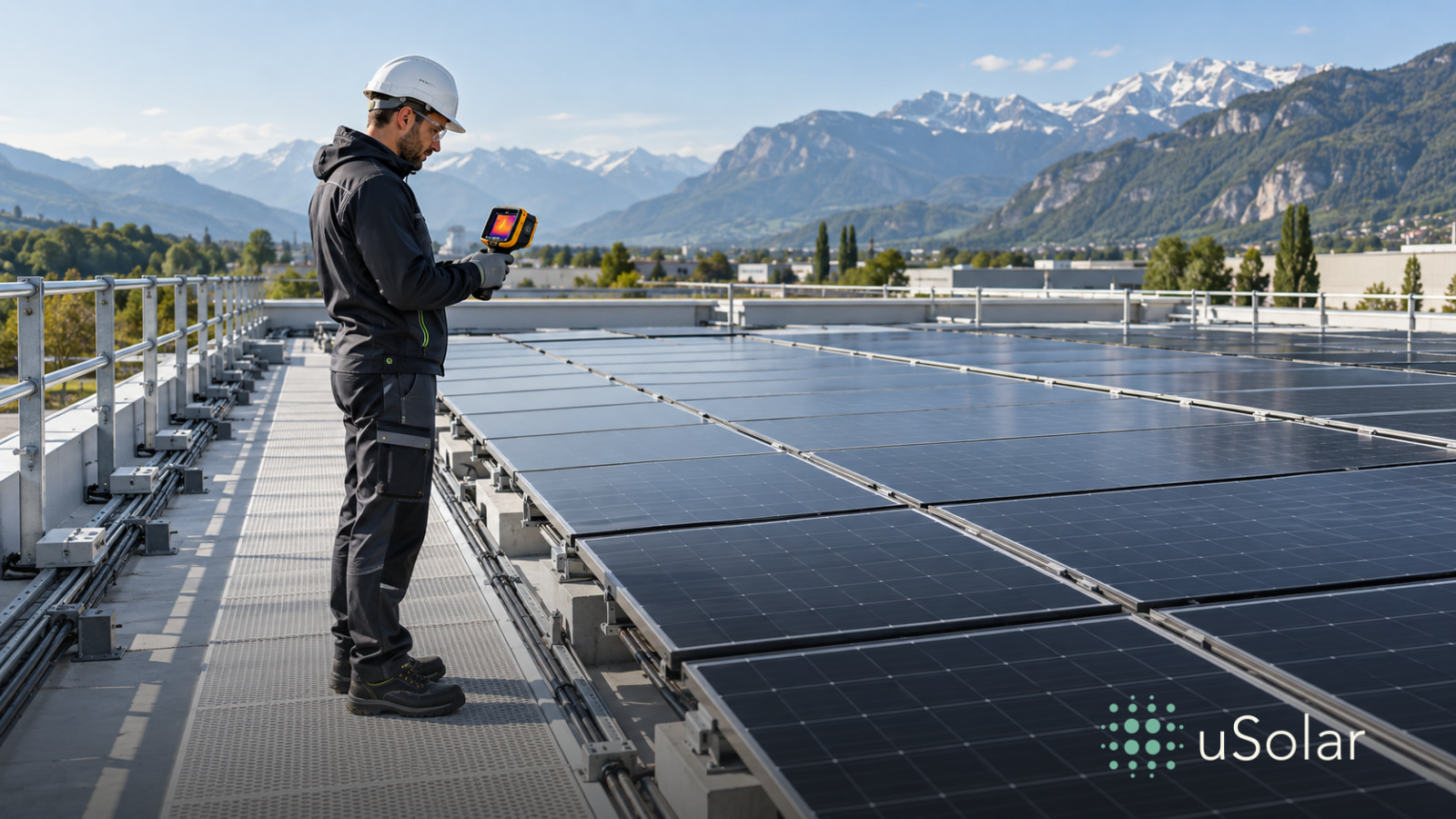
Thermography represents temperature differences and can help locate abnormal behaviors. Illumination, wind, viewing angle, reflections, and operating status all affect the reading and must be considered in execution and interpretation.
A warmer zone therefore requires context. The report should identify the components, describe the conditions of the test, and distinguish observation, possible cause, and recommended further investigation. A color photograph without references does not equal a complete diagnosis.
Good documentation also makes it possible to find the component under examination. Position in the field, identification, and connection to the electrical data are useful for subsequent comparisons; without this traceability, it can become difficult to verify the evolution of the same anomaly.
04 / In Depth
When additional evidence is needed
Electroluminescence can reveal characteristics of cells that are not visible to the naked eye; electrical measurements help evaluate the behavior of the module or string. The choice depends on the problem and the access and testing conditions.
These techniques are not interchangeable and they should not be promised indiscriminately. A well-designed investigation selects the necessary tools to answer a question: is there a relevant anomaly, which component is relevant and which intervention is justified?
05 / In-depth
From the evidence to the decision
Hypothetical example: after an atmospheric event, a persistent difference emerges between two comparable groups. The technician verifies data and conditions, locates the anomaly, and decides whether to further investigate with targeted evidence. Replacement comes after evaluation, not as an automatic conclusion from the first image.
The owner can collect reports and documents from accessible locations, without having to climb on the roof or open electrical components. An ordered report is also useful for manufacturer support or insurance claims, as it keeps track of observations, evidence, and the reasons for the intervention.
The most frequently asked questions
Not automatically. It is necessary to evaluate its electrical significance, its evolution and the relevant safety aspects.
No. It highlights thermal behavior under test conditions; some problems require complementary techniques.
The app can detect abnormalities or differences, but it usually does not identify a physical defect in the cell on its own.

 Italiano
 English (UK)
 Español
 Deutsch (Sie)
