
Hail and photovoltaic panels: assessing visible and hidden damage
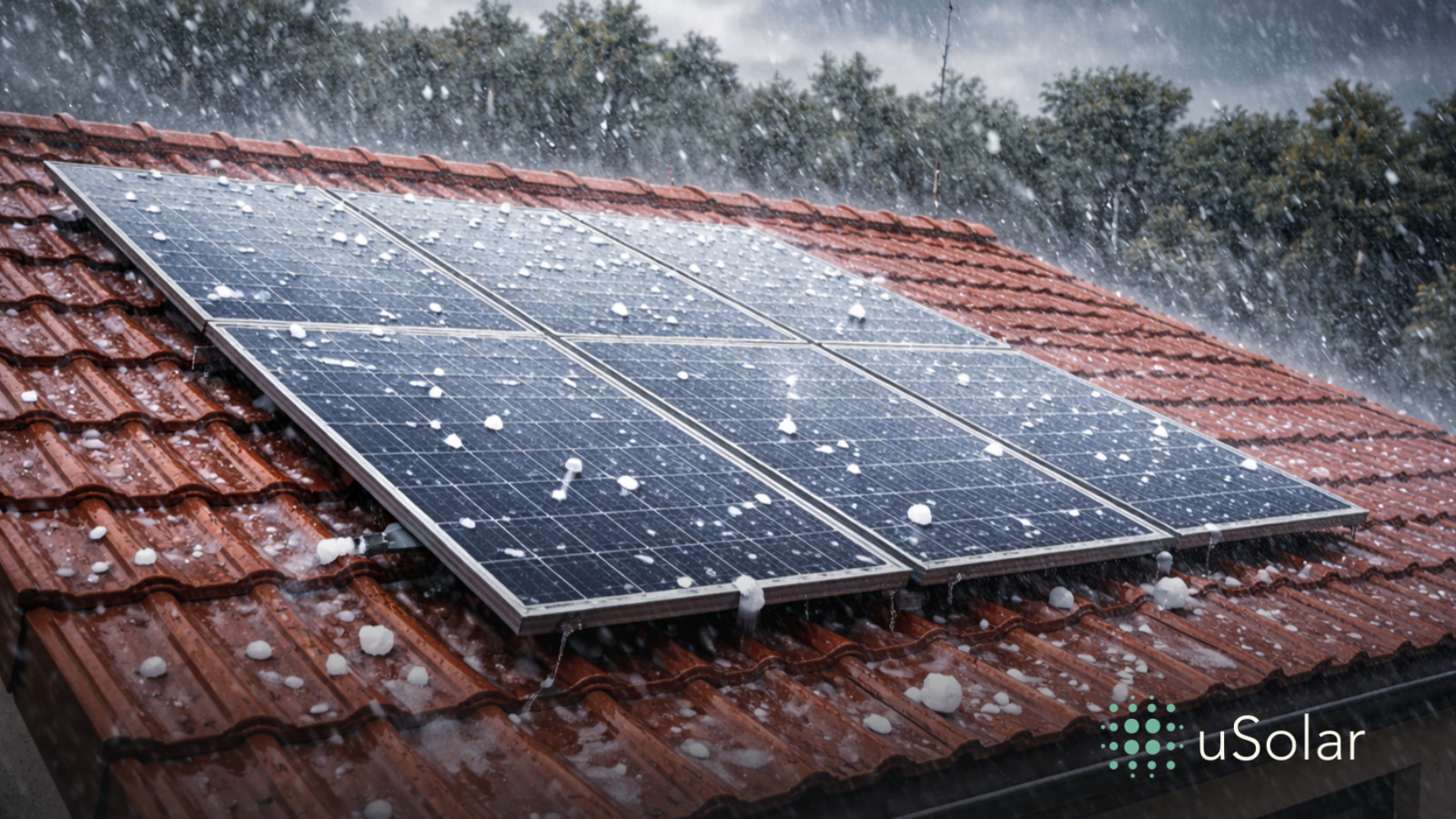
After a storm, a single intact pane of glass is not enough to prove that each module is free of anomalies. At the same time, the event does not automatically justify the replacement of the system: observations, data, and proportionate verification are required.
Published on April 27, 2026
Three points to keep in mind
01
Present production and intact glass do not rule out any anomalies.
02
Keep evidence and documents of the event.
03
Product testing does not guarantee resistance to every type of storm.
01 / In Depth
The first distinction is between safety and performance
Broken glass, deformed parts, or damaged elements require a technical assessment before considering the system to be normally usable. There is no need to approach the modules or climb onto the roof to gather a preliminary report.
The fact that the app displays production does not rule out damage. An installation can continue to generate power while part of it exhibits anomalies, and the absence of an alarm does not replace inspection when there is evidence of a major event.
02 / In Depth
Documenting without altering the evidence
It is useful to record the date of the event, the system messages and any observed changes. Photographs taken from accessible points, component documentation and the production history help the technician to organize the verification and any subsequent contact with the insurance company.
The activities must be coordinated with those involved and with the relevant contractual conditions. Removing or replacing components without adequate documentation can make it more difficult to reconstruct the damage and its consequences.
After the event, an orderly verification
Assessment process without automatic diagnosis or inappropriate access to roof.
01
Reporting and security
02
Evidence of the event
03
Technical inspection
04
Targeted evidence if necessary
05
Documented decision
No threshold of hail or presumed damage.
03 / In-depth analysis
Hidden defects require appropriate tools
The stresses can also affect the cells, with effects that are not always recognizable to the naked eye. Thermography, electrical measurements, and possible electroluminescence all answer different questions and should be chosen based on the available evidence.
The presence of a microfracture does not automatically imply the same loss in every module. The report must link observation, test conditions, and technical significance, distinguishing what is established from what requires further investigation.
04 / In Depth
A test certificate does not eliminate all risks
The hail resistance tests are performed under defined conditions. A real event can have different characteristics in terms of grain size, speed, direction and impact conditions. It is not correct to turn the passing of a test into a promise of resistance to any type of weather.
When choosing components, it is useful to know the actual documentation of the model and the installation configuration. The structure and assembly are also part of the system to be evaluated, without assigning an absolute protection to the name of the panel alone.
05 / In-depth
An example of proportionate verification
Imagine a storm followed by apparently normal production, but with evident damage to elements close to the photovoltaic field. The process can begin with reconstructing the event and conducting a technical inspection to decide whether further testing of the modules is necessary.
It is an example of a process, not a real case. The goal is not to multiply exams for no reason, but to reach a documented decision: keep the system in operation under the assessed conditions, deepen it or intervene on the affected components, with responsibility and clearly described results.
When comparing the productions before and after the event, the change in weather must also be considered. A less bright day the following day does not prove damage; similarly, a total similar to that does not rule out a problem limited to a part of the field.
The most frequently asked questions
No. The decision depends on the checks and conditions of the individual components and the system.
Not in every situation. The coach chooses the tests based on the question and the evidence gathered.
The inspection of the enclosure and the electrical components should be entrusted to trained and competent personnel. Only collect information from accessible locations.

 Italiano
 English (UK)
 Español
 Deutsch (Sie)
