
Fire safety of photovoltaic systems: design, roof and controls
The safety of a photovoltaic system depends on the entire system: components, connections, cover, layout, and management over time. No single device replaces a proper project. For buildings and activities subject to Fire Department inspections, it is also necessary to integrate photovoltaics into the fire safety assessment, with updated references.
Published on June 8, 2026
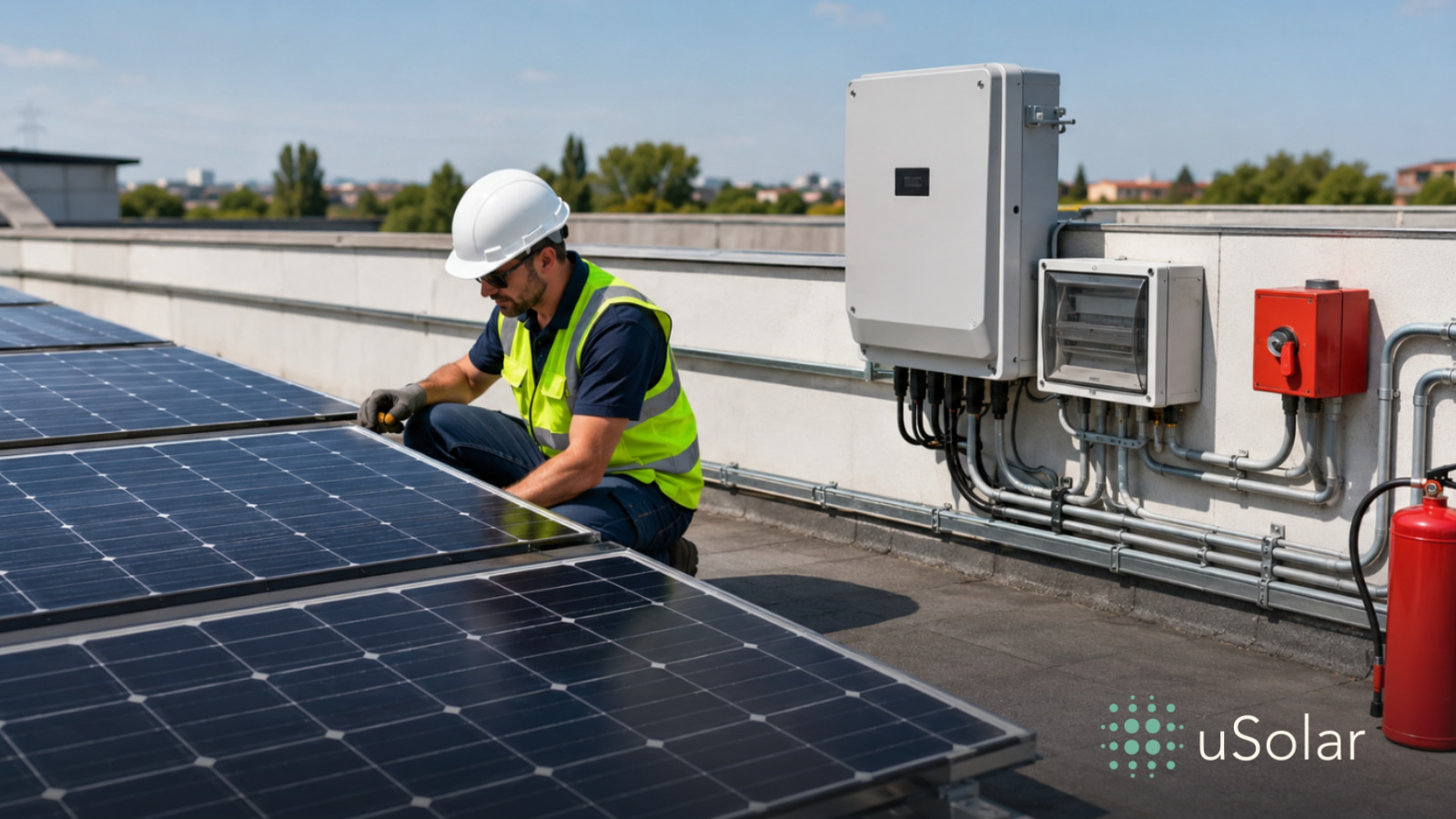
Three points to keep in mind
01
The VVF 2025 guide has a precise scope of application.
02
The roof, installation, and components should be considered as a system.
03
Monitoring, documentation, and physical controls play complementary roles.
01 / In Depth
When Firefighters' guidance comes into play
Note 14030 of September 1, 2025 updates the previous technical guide of 2012. It concerns installations located within or in service of activities subject to fire prevention procedures. Photovoltaic power generation, by itself, is not one of the activities listed in D.P.R. 151/2011: therefore, it cannot be said that any home with panels must follow the same practice as an activity subject to the same regulations.
When the installation concerns an activity subject to regulation, its introduction or modification must be assessed in the relevant procedure. The verification of any potential increase in risk and the documentation requirements are the responsibility of the designated personnel. A good assessment addresses the issue before installation, when layouts and routes can still be coordinated.
02 / In Depth
The cover is a system of layers
The fire performance of the roof is not determined by the visible sheet metal alone. The cladding, insulation, support and installation configuration contribute to the assessment; the documentation must be relevant to the actual solution. The fire reaction of the materials and the fire resistance of the elements are different properties and should not be used as synonyms.
The presence of a combustible insulator does not allow either to automatically declare photovoltaic technology impossible, nor to ignore the problem. Verification of the package and its coupling with modules and structures is required. Similarly, a classification of the roofing system does not extend to any stratigraphy or installation other than the documented one.
Security comes from the whole
Roof, electrical installation, accessibility and management all contribute to the evaluation.
01
Cover and materials
02
Components and connections
03
Accesses and emergencies
04
Checks and documents
05
Coordinated assessment
03 / In-depth analysis
Connections and installation deserve the same level of attention as the modules themselves.
A safe project must consider compatible components, connections, protection, and wiring, control panels, inverters, and environmental conditions. A certified component alone does not demonstrate the correctness of the entire system. The quality of the construction is also evident in the details that remain hidden after installation.
For the operator, it is useful to have up-to-date documentation, identification of circuits, compliance documentation, and manuals. If inners are replaced, modules are added, or paths are modified over the years, the documentation must continue to represent the actual system. An organized archive helps both maintenance and the management of anomalies.
04 / In Depth
Accesses and emergency devices are part of the project
The arrangement must not be evaluated solely based on the number of panels that can be installed. It is necessary to consider openings, skylights, smoke and heat extraction, partitioning and accessibility. The applicable distances and routes must be verified on a case-by-case basis, while preserving the operational capabilities of the maintenance personnel and emergency responders.
The disconnection devices must be identifiable and consistent with the design. Switching off an inverter does not automatically mean that all photovoltaic components exposed to light are considered to be without voltage. Staff must be aware of the relevant procedures; in the event of smoke or fire, it is not advisable to make any unscheduled interventions to the electrical system.
05 / In-depth
Timely checks, in addition to the monitoring app
Energy monitoring can signal production declines or alarms, but it does not replace all physical checks. An operating plant can still require checks on connections, cables, supports, or roof conditions. Inspections and measures should be planned according to the plant, documentation, applicable standards, and operating conditions.
The VVF guide includes instructions on maintenance, recording and checks for fire risk. The frequency should not be converted into a single commercial frequency for each house or facility: it must be aligned with the scope of application and the plant plan. Thermography and other checks have value when carried out and interpreted under appropriate conditions.
06 / In Depth
A concrete assessment starts with the documents
For a new project, data on existing activity, roof and installations are needed. For an already installed system, electrical diagrams, compliance, manuals, history of interventions and monitoring reports are useful. The goal is to identify what needs to be verified or updated, without promising “zero risk” or prescribing a roof replacement based on a single material.
The most frequently asked questions
Not alone. The activity in which it is installed and the application of fire prevention procedures must be verified.
No. The roof build-up and photovoltaic solution must be assessed together; a material name alone does not establish a universal outcome.
No. Monitoring does not replace the physical and documentary checks required for the installation and for the activity.

 Italiano
 English (UK)
 Español
 Deutsch (Sie)
