
ABC AIKO technology: what changes in the cell and the project
ABC stands for All Back Contact: the cell’s electrical contacts are located on the back, leaving the front without the traditional metal grid. This is an important technological choice, but its value on the roof depends on the precise module and design. Efficiency, installable power, and annual production remain different magnitudes.
Published on June 10, 2026
Three points to keep in mind
01
ABC indicates contacts behind the cell, not total conversion of light.
02
Efficiency helps to compare power per surface area, not the annual savings.
03
The model sheet, layout and guarantees must be read together.
01 / In Depth
The contacts are on the back of the cell
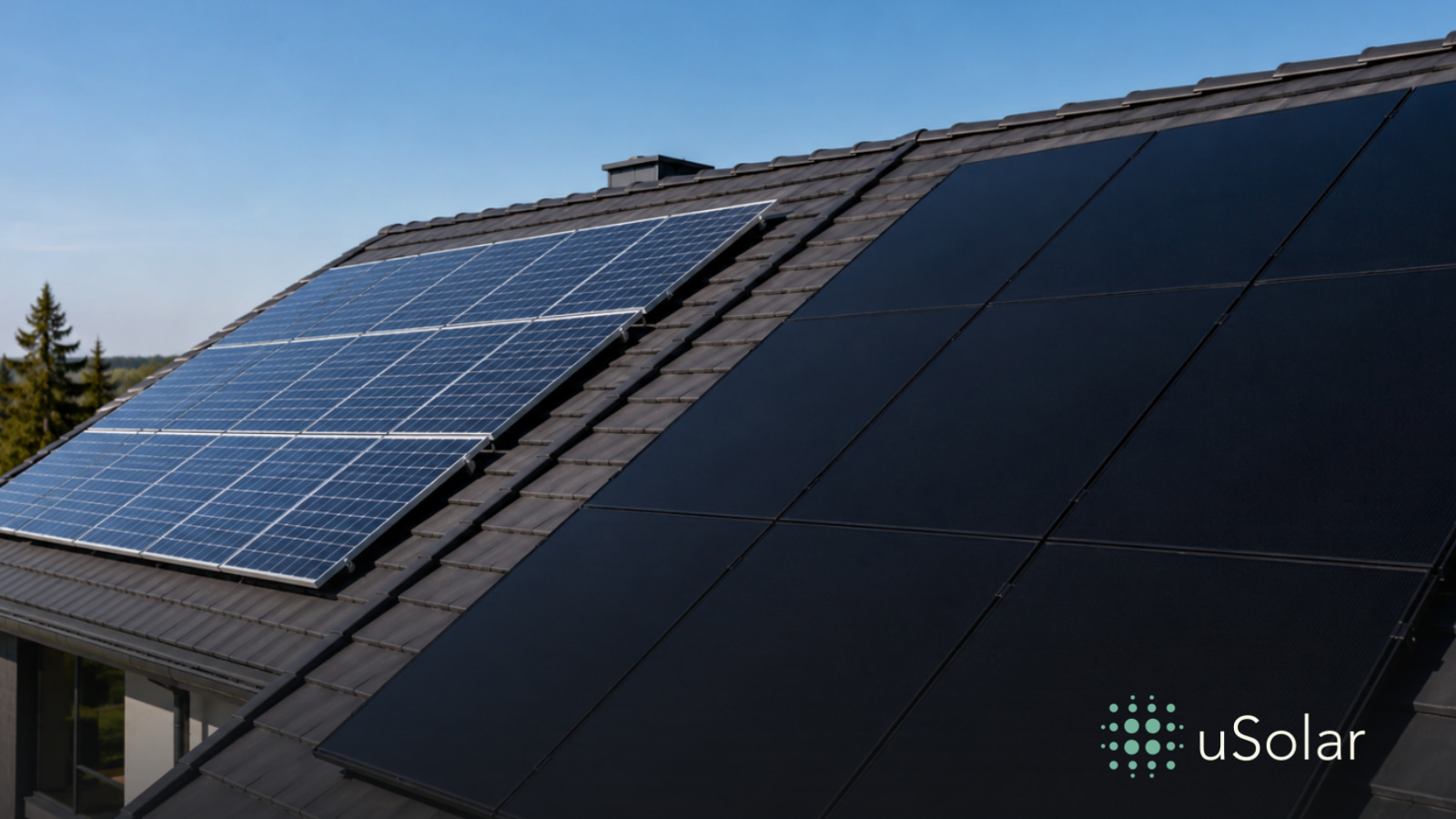
AIKO’s ABC technology uses N-type cells with rear contacts. It is more accurate to talk about the back of the cell, not generically about the back of the panel: the cell, connections, and module structure are different levels. The free front of the contacts also contributes to a more uniform appearance.
This does not mean converting all the light received into electricity. There are still physical, optical, and electrical losses. The efficiency of the board indicates the percentage converted under test conditions; a commercial description of the illuminated surface should not be confused with a 100% efficiency rating.
02 / In Depth
More efficiency means above all more power per surface area
On a limited roof, a more efficient module can allow for the installation of more power in the same area. However, the result also depends on the size of the panels and how they fit into the layout: chimneys, distances, and passageways can change the number of panels that can be installed.
Educational example, without reference to a product: with 10 m² of module surface area, a test irradiation of 1,000 W/m² and an efficiency of 20%, the power is 2 kW; at 24% it becomes 2.4 kW. It is not annual kWh nor an estimate of savings. The actual roof includes additional spaces and constraints.
Efficiency and surface: an example
Educational scenario with 10 m² of modules and 1,000 W/m² of irradiation: 20% → 2 kW, 24% → 2.4 kW. No reference to a product or annual production.
Efficiency 20%
2 kW
Efficiency 24%
2.4 kW
Module surface area 10 m²
Emittance 1,000 W/m²
Uniform test conditions
Set-up areas and restrictions excluded
03 / In-depth analysis
Temperature matters, even with advanced cells
The rated power is declared under standard conditions, with a cell temperature of 25°C. In operation, the temperature may be different from that of the air. The temperature coefficient helps to estimate how the power varies, without canceling the role of ventilation and positioning.
For example, the NEOSTAR 3P54 AIKO-A-MCE54Mw 470–500 W, revision 202608 V1.1, has a power coefficient of −0.26%/°C. This is a data from that family and revision, not a characteristic that can be attributed indiscriminately to every ABC module present or future.
04 / In Depth
Shades and resistance: reading the correct evidence
Cell technology can influence shading behavior and stresses, but it does not make obstacles irrelevant. A project must still analyze the shadows and coordinate modules, strings, and inverters. A laboratory test cannot be transformed into a guaranteed production percentage on site.
Mechanical resistance, hail and fire performance must also be verified in the documentation of the module and in the mounting conditions. A test of the component does not automatically certify the entire cover or any installation. The intended fixing and the structure that supports it remain essential.
05 / In-depth
A uniform aesthetic does not identify a single range.
ABC describes the cell technology; names like NEOSTAR identify families of products with variations. Color, size, single or double glazing, power and warranties can change. A double-glazed module is not automatically bi-fold: you need to read its datasheet.
For a visible roof, the overall result also counts: alignment, layout, passages and finishes. Uniform color can be an aesthetic advantage, but it does not replace the verification of compatibility with the building and the applicable constraints.
06 / In Depth
How to compare an AIKO ABC proposal
Ask for the complete model code, the corresponding datasheet and the planned layout. Compare the total installed power and estimated production with the same assumptions, weight, mounting and warranties. The wattage of the individual panels alone does not allow for an assessment of the entire system.
The performance guarantee concerns power under defined conditions; it does not promise the same amount of energy every year. A well-reasoned choice shows where technology helps your project and where, instead, orientation, shadows, and consumption remain decisive factors.
The most frequently asked questions
No. The module’s behavior can be different, but the shielded light energy remains unavailable and the shadow must be analyzed in the design.
Given the same conditions, it can offer more power per area. The output of the system also depends on the layout, orientation, shade, and losses.
No. Duration, performance and conditions depend on the model, version and documentation applicable to the supply.

 Italiano
 English (UK)
 Español
 Deutsch (Sie)
