
Regulations, incentives and tax policy / DDL in Parliament
Budget 2027 and photovoltaics: measures for homes, businesses and public bodies
Deductions, contributions and energy investments: a guide to the proposals, their beneficiaries and the conditions to be known before planning.
Text verification: November 11, 2026 · AC 3174-bis
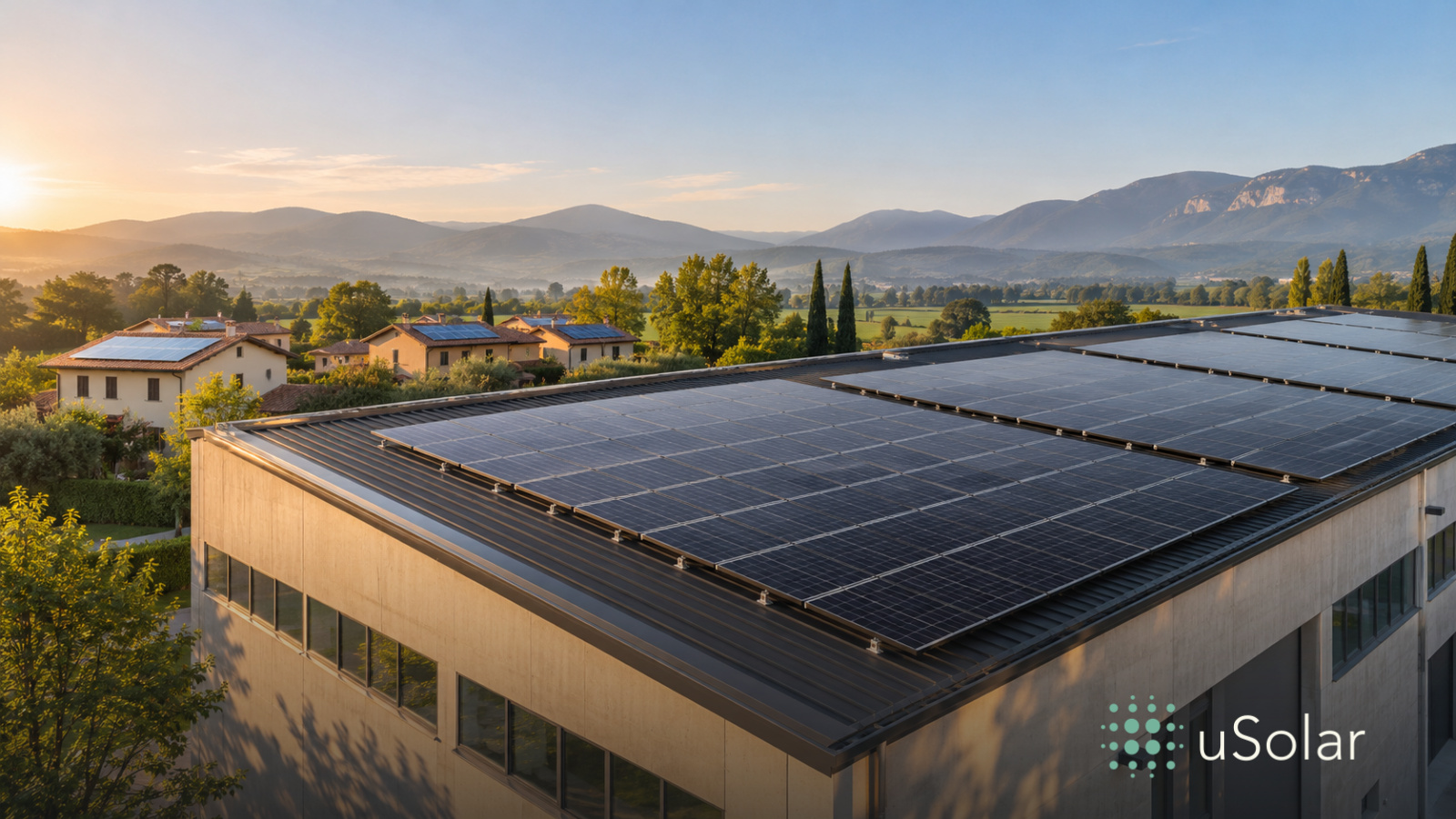
A family considering photovoltaic power generation, a business with high consumption, and a school to be renovated can read the same manual and find very different opportunities. The useful question is: Which measure really concerns my project, and what does it require?
As of November 11, 2026, the 2027 Budget is still being reviewed by the Chamber. The measures described here are those of Text A.C. 3174-bis: they may change during the parliamentary process. They are not, simply because they are included in the DDL, any concessions that can already be claimed. Official sources and the status of the proceedings.
Article 4 / Families
House: the 50% should be read in conjunction with the requirements
The DDL proposes a deduction of 2027 for expenses related to 36%, Elevated to the 50% when the cost is borne by the owner or holder of a right of enjoyment and the intervention concerns the unit intended for main residence.
Therefore, it is not enough to call the property “first home”. The text links the increased rate to both the position of those who support the expense and the use of the dwelling. For building renovation, it indicates a total spending limit of 96,000 euros per property unit; the other schemes retain their own scope, maximums, and requirements.
For those who think about Photovoltaic for home or condominium, The assessment must start with concrete action. Home improvement, energy efficiency and anti-seismic measures are not interchangeable labels: a photovoltaic system does not automatically become an eco-bonus measure.
A deduction also reduces the tax according to the applicable rules: It is not an immediate discount on the quote. Before including the benefit in the economic plan, the verification of the paying entity, the requirements, the documentation, and the possibility of using the deduction must be carried out.
Source: A.C. 3174-bis, art. 4. Quotation and conditions proposed for 2027, not definitively approved.
Article 79 / New installations
Photovoltaic up to 1 MW: what does the contribution of up to 40% mean?
The text proposes capital contributions, managed by the GSE, not exceeding 40% of the eligible costs for new photovoltaic installations with a nominal power of up to 1 MW. The total quota planned is 3 GW.
The condition that changes the reading of the measure is access to the mechanism provided for by the MASE decree of June 18, 2026, the FER X on a regime. The proposal therefore does not describe a universal bonus for any household or business installation. Even 40% is a ceiling, not a guaranteed percentage across the entire cost.
The planned resources are 800 million euros in 2028, 200 in 2029 and 200 in 2030. Criteria and modalities should be defined by a MASE decree, in concert with the MEF for financial aspects, within 120 days of the law’s possible entry into force.
For an industrial project, the practical consequence is to assess together the sizing, consumption profile, connection and compatibility with the support scheme. The profitability must be based on the operation of the plant; the contribution can only be considered when the project is found to be eligible under the final rules.
Source: A.C. 3174-bis, art. 79; notice of the MASE decree of June 18, 2026, published in the Official Gazette. The new proposed contribution is distinct from the FER X mechanism referred to above.
Resources, without confusing the measures
Four instruments, different recipients and different years
The graph compares the multi-year allocations proposed for four energy measures. They are spending limits: they do not include amounts already allocated to beneficiaries and do not account for savings achievable from a single project.
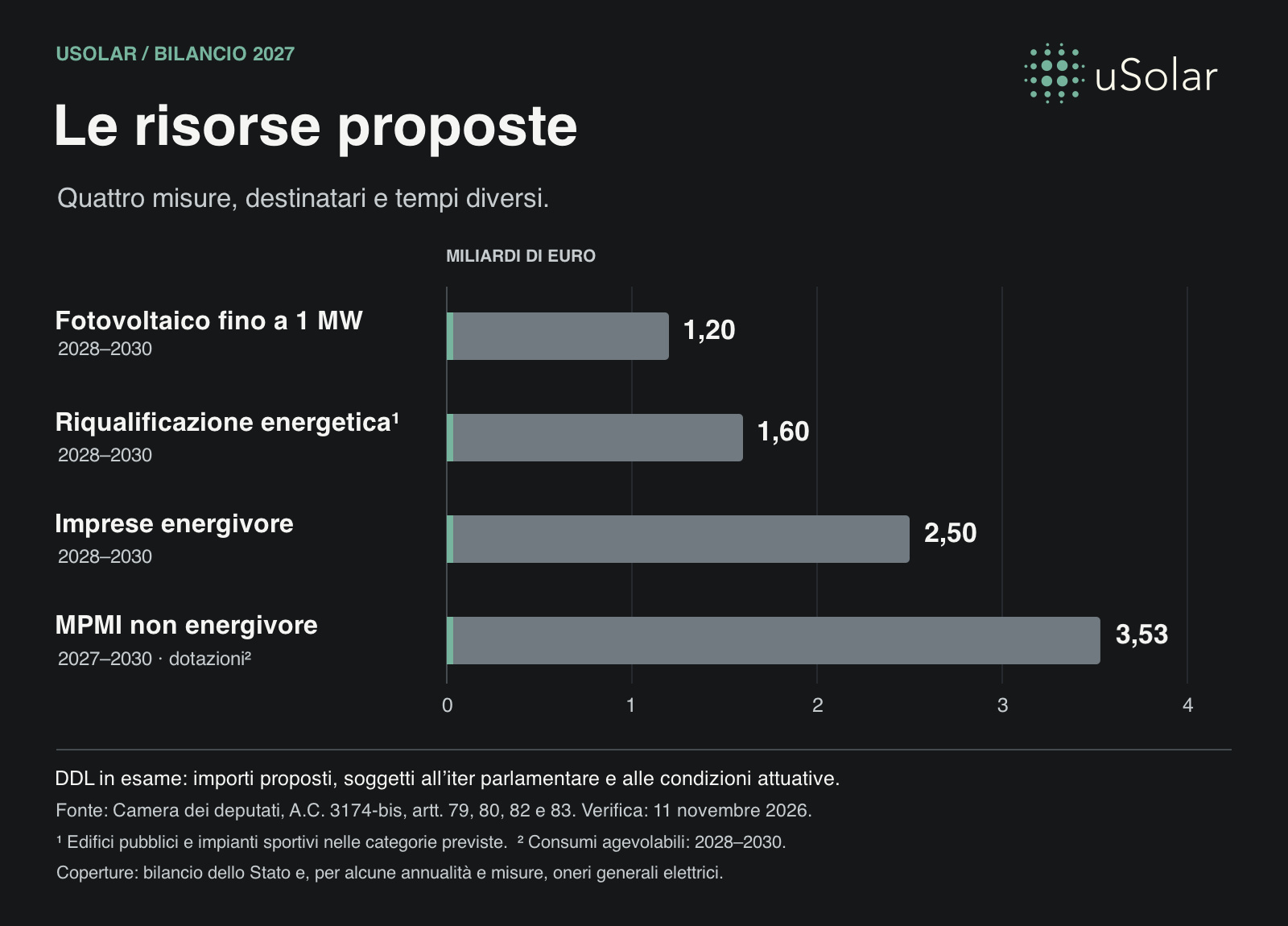
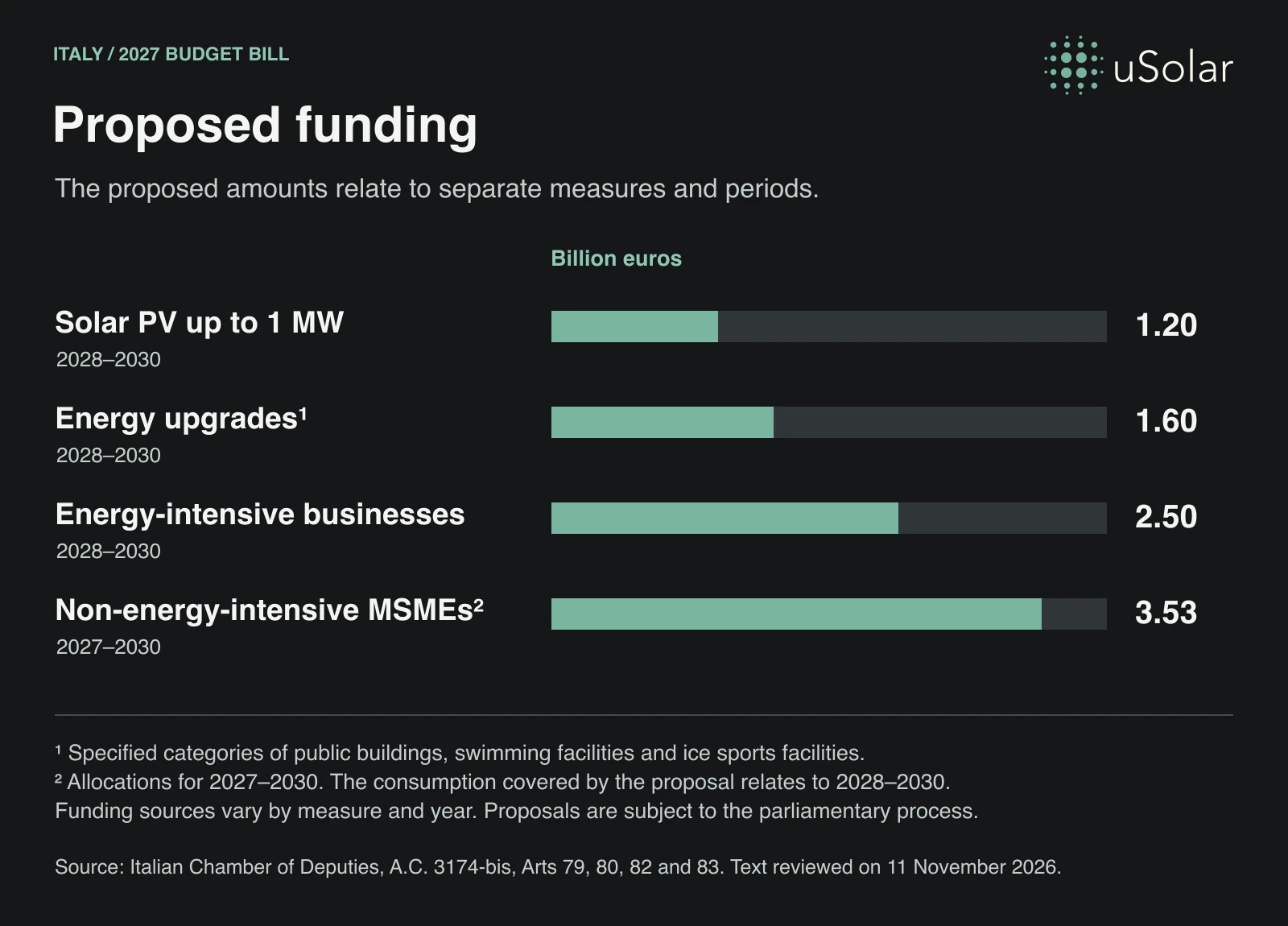
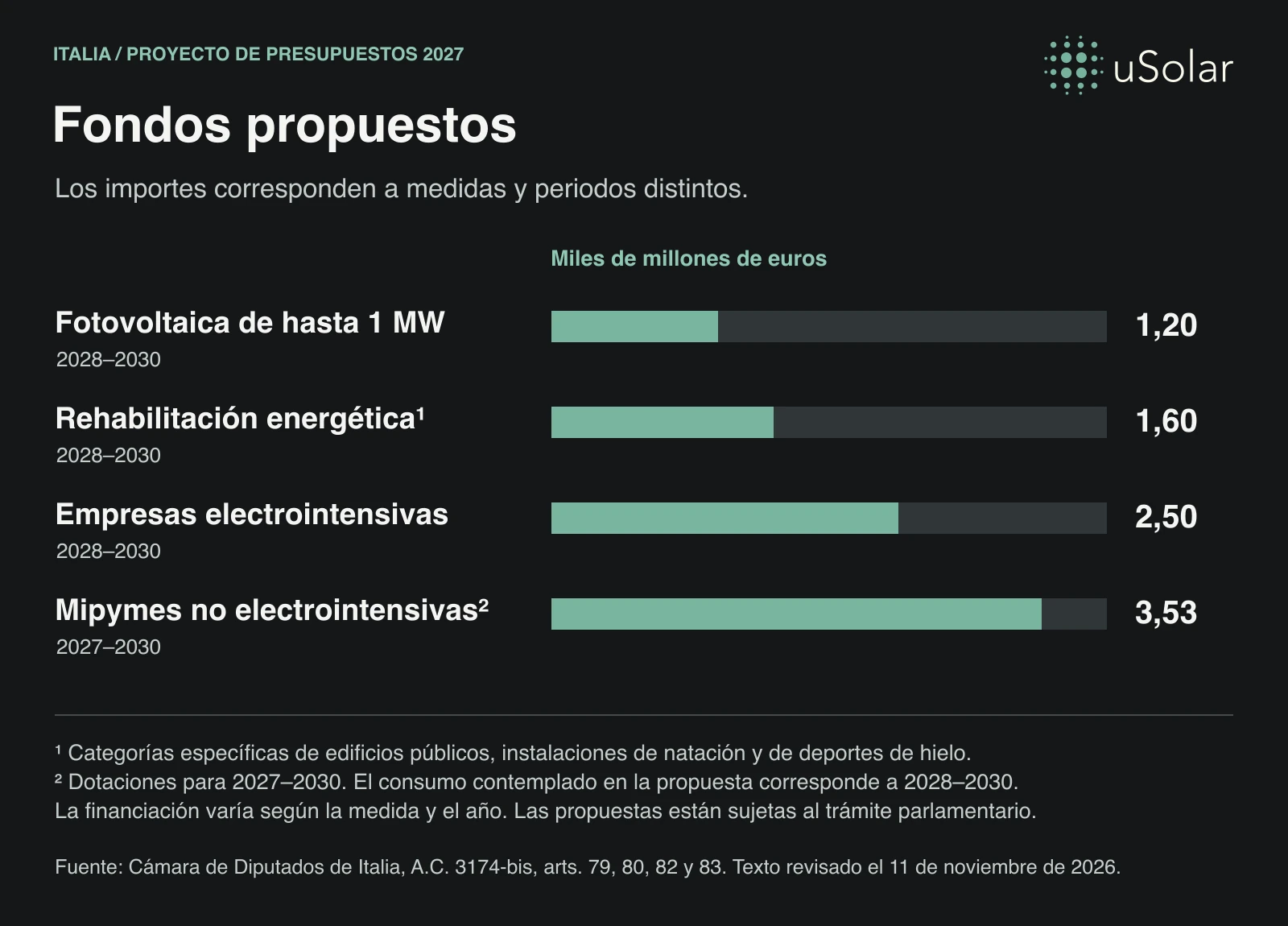
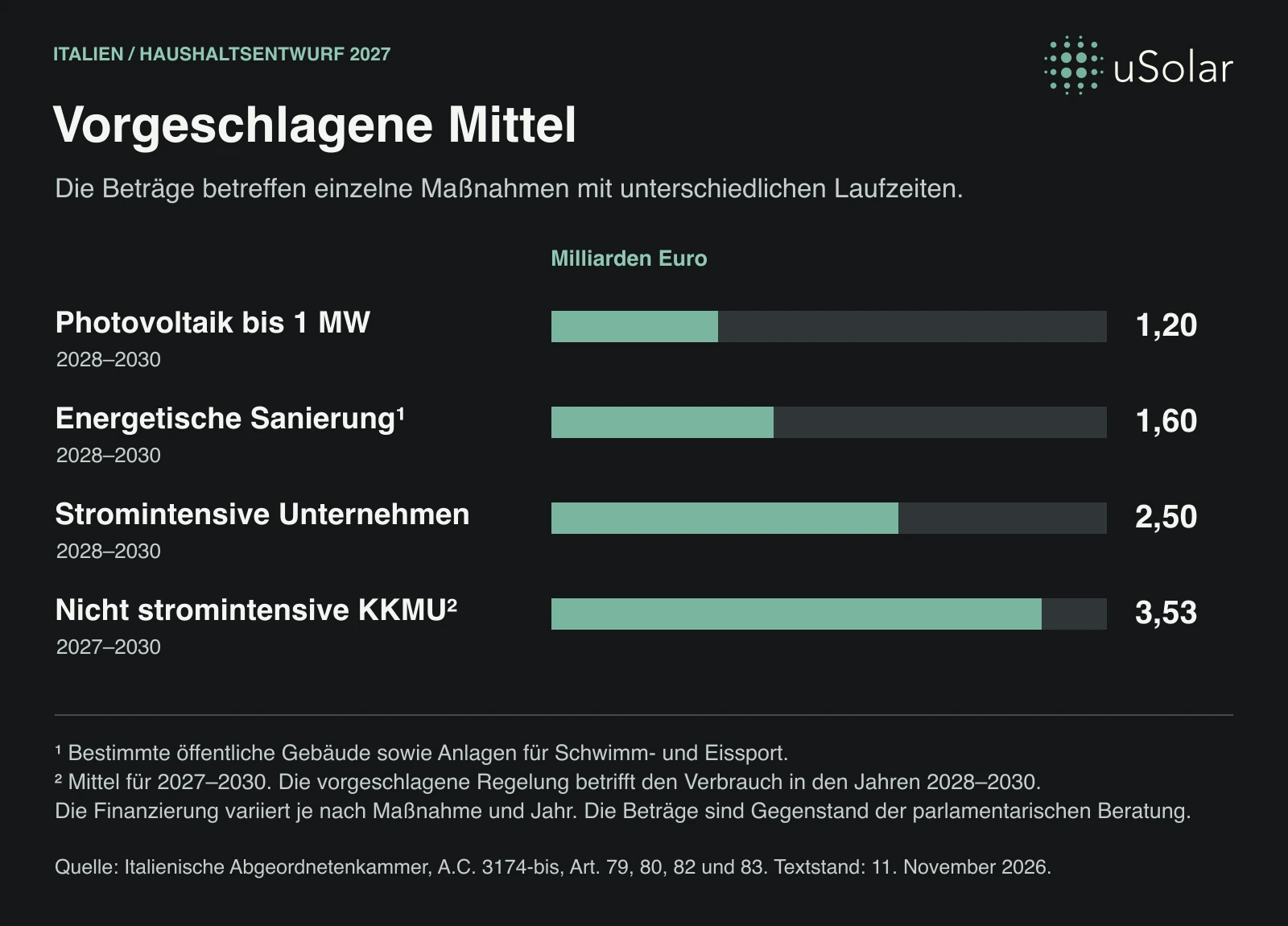
Click on the graph to enlarge it.
| Proposed measure | 2027 | 2028 | 2029 | 2030 |
|---|---|---|---|---|
| FV up to 1 MW | — | 800 | 200 | 200 |
| Buildings and sports: categories of Article 80 | — | 600 | 500 | 500 |
| Energy-intensive companies | — | 1.000 | 800 | 700 |
| MPMI non-energy consuming | 1.000 | 1.430 | 600 | 500 |
“—” means that the specific article does not indicate a budget for that year; it does not mean that other incentives are lacking. For SMEs, the schedule of appropriations and the schedule of consumption referred to in the text do not coincide: the distinction is explained below.
Articles 82 and 83 / Companies
Electricity subsidies linked to new investments
For businesses, the DDL proposes two paths of temporary support: one for small and medium-sized enterprises and another for large companies. energy-consuming registered in the CSEA list and belonging to the admitted sectors, the other for the micro, small and medium-sized non-energy-consuming enterprises.
The aid structure takes into account a share of the average wholesale price in the reference electricity zone and a share of annual consumption: both of which are not higher than 50%. It does not mean halving the bill. The invoice contains different components, and the result would depend on the calculation base, caps, and implementation rules.
Reinvestment is a condition
In both cases, the beneficiary should allocate additional resources to additional investments. at least equal to 100% of the aid received. The investments must be initiated after the application and relate to the energy transition, according to the list and conditions of the respective measure.
Among the areas covered are renewable energy production, storage, efficiency and electrification. For SMEs, the text also mentions heat pumps, heat recovery and intelligent consumption management, and provides for completion within 36 months of the grant, subject to a different deadline set by the European Commission.
Practical distinction is important: it is not about receiving help and then freely deciding whether to invest. The company should develop a coherent program, document it, and adhere to its terms, with checks and possible recoveries in case of non-compliance.
Resources and operationality are two different things
For energy-intensive companies, the DDL indicates a total of 2.5 billion in 2028–2030. For non-energy-intensive SMEs, it proposes 3.53 billion in 2027–2030. Both instruments require implementing decrees and Authorization by the European Commission.
For SMEs there is also a point to be taken into account: Article 83 already allocates funds in 2027, while the support formula refers to consumption for the years 2028–2030. It is therefore not correct to infer, from the mere allocation, an operating discount from 2027. The timeline needs to be clarified further in the process and in its implementation.
Source: A.C. 3174-bis, articles 82 and 83. The proposals also provide for GSE controls and limits on cumulation, double financing and overcompensation.

Article 80 / Building heritage
Public buildings and sports facilities: an energy target to measure
The proposal allocates 1.6 billion in 2028–2030 to the redevelopment of specific categories: hospitals and public health facilities, public schools, state universities, AFAM state institutions, buildings and infrastructure of public research bodies supervised by the Ministry of the Interior, swimming pools and ice sports facilities.
It is not an indiscriminate funding for every public building or sports facility. Moreover, for swimming pools and ice sports, the text does not explicitly limit the intervention to only public facilities.
The DDL provides for the possibility of fully covering the identified interventions, provided that a certain level of compliance is achieved. reduction of the primary energy requirement by at least 30%. We are talking about the energy performance of the intervention: not about a guaranteed reduction in the bill at the same percentage.
Technical requirements, allocation criteria and verifications would depend on one or more decrees. For an entity or a manager, the first useful step is therefore to reconstruct consumption, the characteristics of the building and possible integrated interventions. Photovoltaic energy can be included in the technical assessment, without this alone proving the eligibility of the expenditure for the measure.
Source: A.C. 3174-bis, art. 80. Proposal to strengthen the schemes for renewable thermal energy and energy efficiency.
Articles 21, 85 and 88
IRAP, ZES and Agriculture 4.0: the other measures to be aware of
IRAP: concerns identified energy activities
Article 21 proposes an increase in the IRAP of 5 percentage points in 2027 and of 3 points in 2028 and 2029, For entities with operations coinciding with the solar year that predominantly carry out the energy activities listed in Annex 2. The text prohibits transferring the burden of the surcharge to customers.
Therefore, it is not a new tax that is automatically applied to every company that installs an installation on its roof. The prevailing activity and its belonging to the indicated codes must be verified with the tax advisor.
ZES unique: resources for investment, not automatic access
The proposed refinancing brings the amounts of the ZES single tax credit to 2.4 billion in 2027 and 1.25 billion in 2028. These are total allowances, not increments to be added to other amounts. For an investment, it is necessary to verify the territory, the company, the sector and the eligible expenses: this article does not automatically make any photovoltaic system eligible.
Agriculture 4.0: more attention to process consumption
Article 88 proposes to include, among the objectives of investments in new capital goods for agriculture, fisheries and aquaculture, the improvement of energy efficiency and the reduction of consumption in company facilities and production processes.
It is an interesting signal for companies that want to link production and energy use. However, this does not mean that every panel or battery is eligible: the product, the characteristics of the investment, and the credit requirements still need to be verified.
Source: A.C. 3174-bis, art. 21 and annex 2, art. 85, art. 88, paragraph 1. Proposed measures, with separate disciplines and beneficiaries.
Article 84 / Social plan for the climate
Managing the Plan is not a new bonus program
The DDL entrusts the coordination and control of the Social Climate Plan to the MASE, providing for a Mission Unit until the completion of the Plan and in any case no later than December 31, 2033. The monitoring also involves the ReGiS system.
This is a provision regarding the organization and implementation of the Plan. This article cannot be used to derive a new individual bonus that has already been opened, nor an amount due to a family. The concrete opportunities must be read in the specific measures and their procedures.
Source: A.C. 3174-bis, art. 84.
The path to operationalization
What must happen before a request
The final law is a decisive step. For some measures, decrees, European authorizations, and application procedures are also required: the timing and conditions are not the same for everyone.
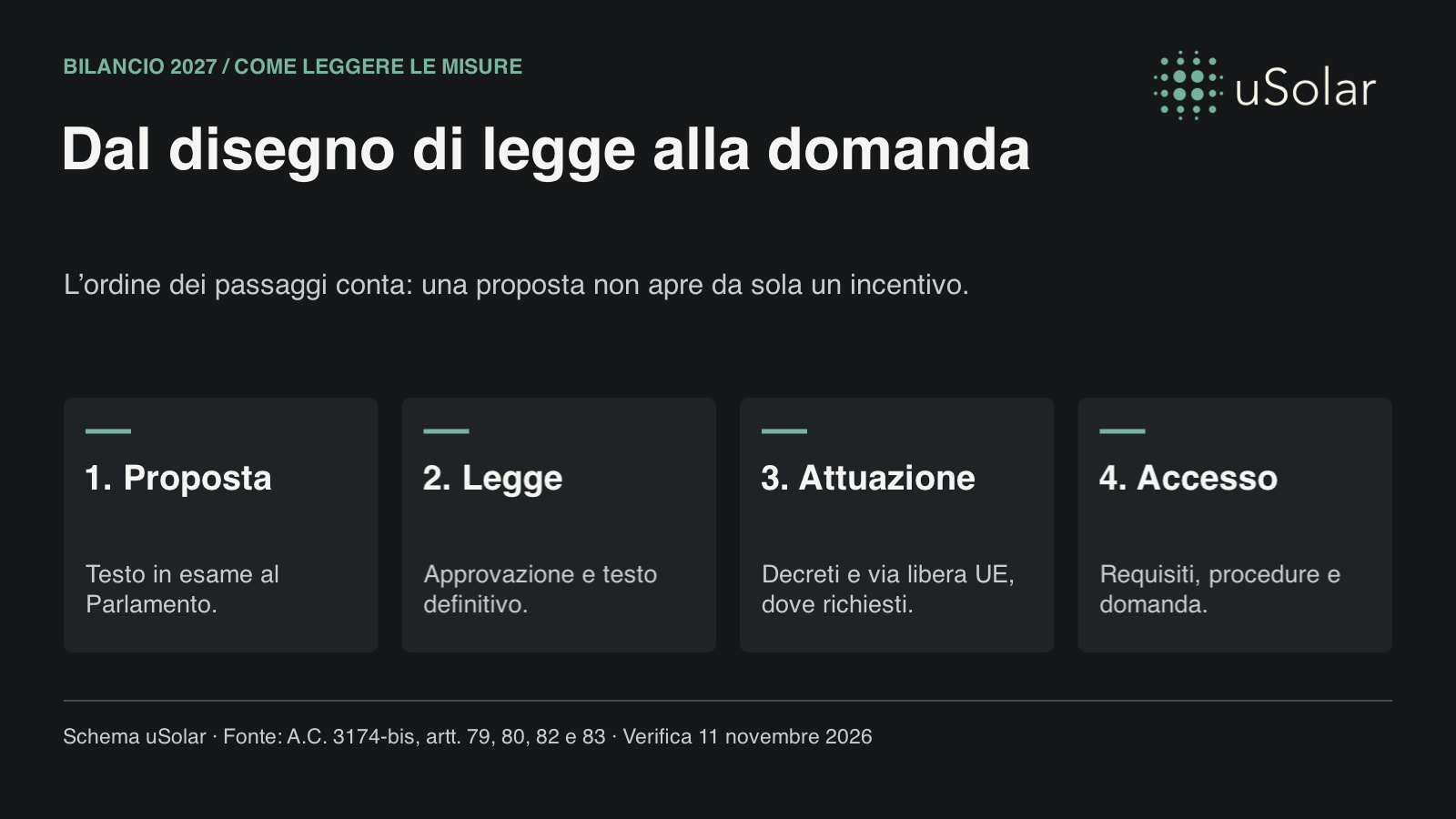
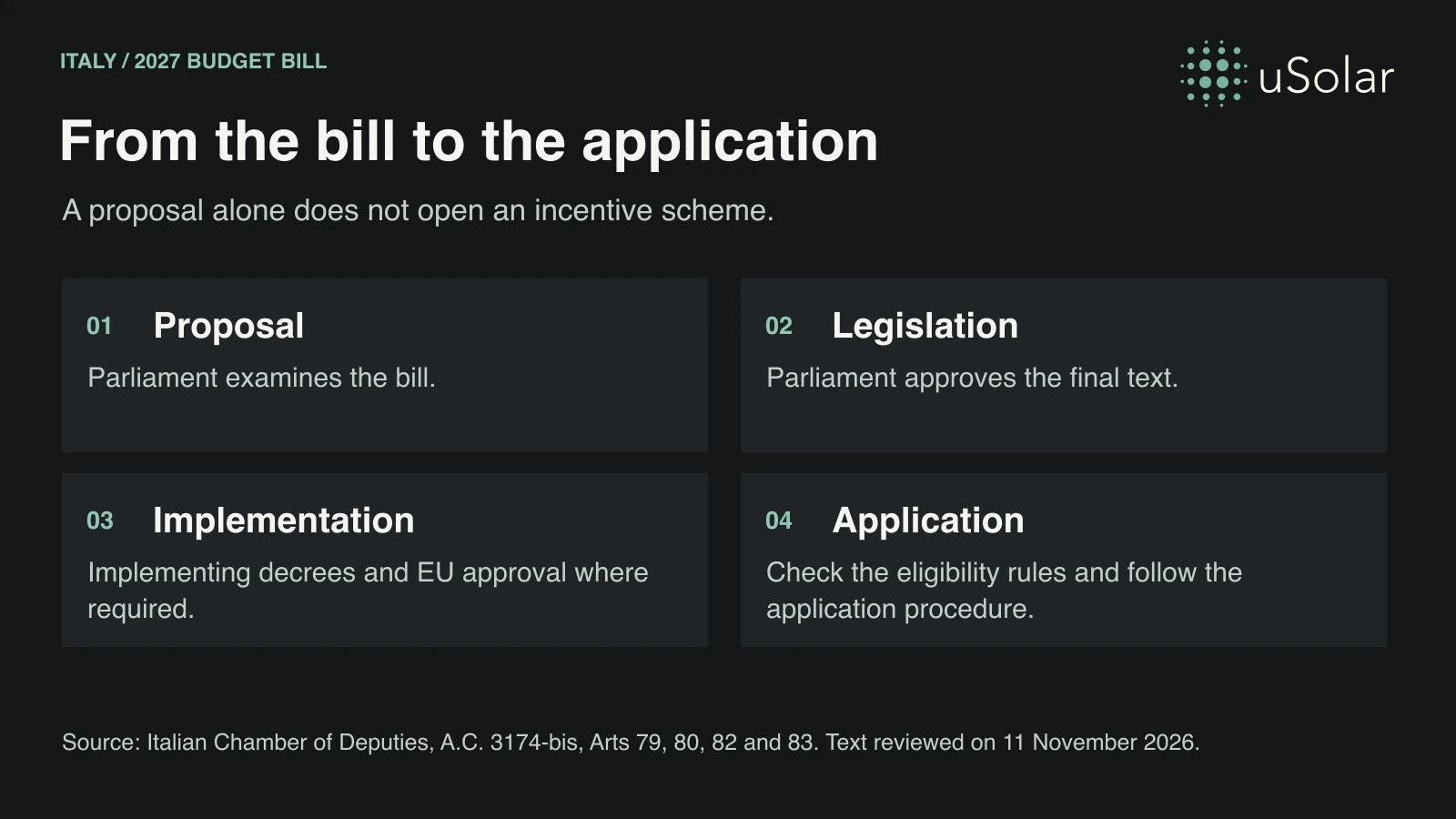
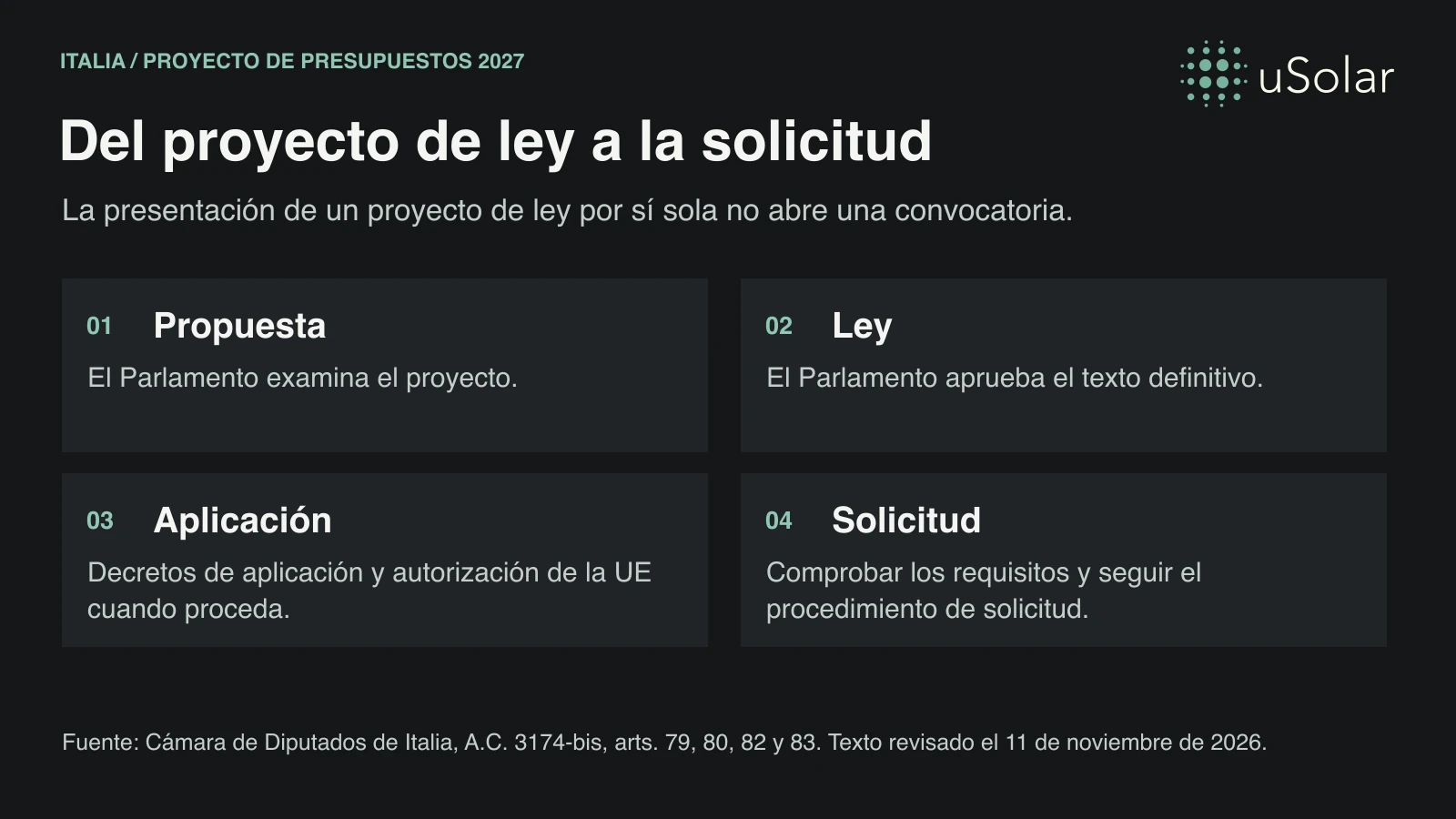
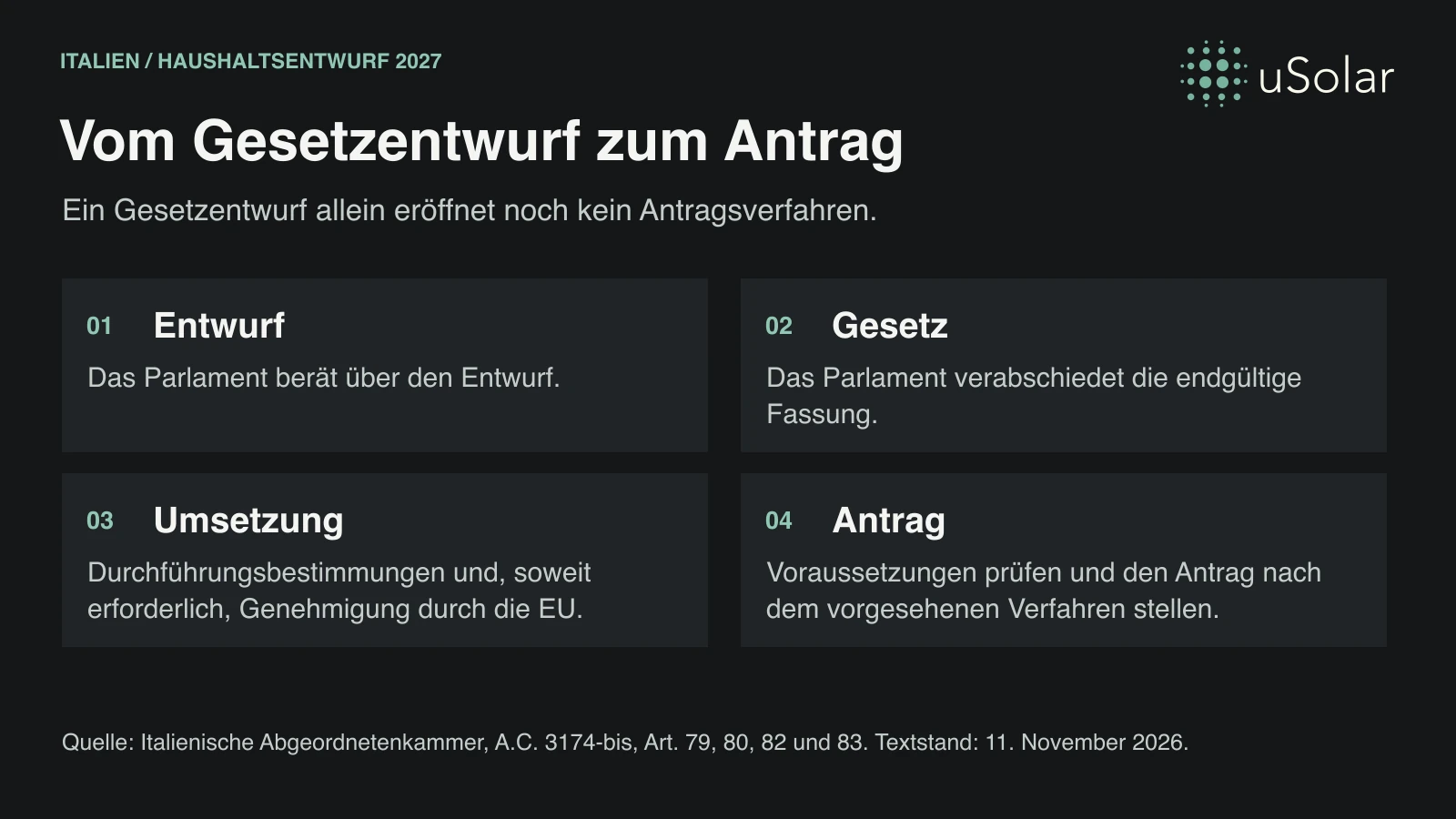
Click on the scheme to enlarge.
- FINAL TEXT
What is approved
Check whether the import, beneficiaries and requirements are confirmed after the amendments have been made.
- APPLICABLE RULES
How the measure works
Check the decrees and permits required, eligible expenses, the accumulation and sequence of the investment.
- PROJECT AND REQUEST
If the specific case falls within
Compare technical data, documents, and project timelines with the actual operational conditions.
The uSolar perspective
What can be prepared already now
The technical work can begin before an incentive becomes operational. For a home, it means understanding when energy is consumed and what needs to be covered. For a business, it means knowing the loads, schedules, and the relationship between photovoltaic production and operations. For a complex building, it requires reading the envelope, the systems, and the consumption together.
- Collecting the data: bills, available consumption, usage times and seasonal variations.
- Check the website: surfaces, conditions of the covering, technical spaces, connection and constraints.
- Defining the objectives: self-consumption, peak management, efficiency or electrification, distinguishing the real needs.
- Prepare the economic comparison: costs, expected performance and explicit assumptions, separating the value of the project from the benefit yet to be confirmed.
This does not mean placing orders or starting work without checking the rules: for the aid to businesses described here, for example, the text links eligibility to investments initiated after the application. It means reaching a decision with a readable project and with the necessary data to verify it.
uSolar can support the technical evaluation of the photovoltaic on the industrial roof and home improvement systems. The tax verification and the requirements of the incentive scheme must be coordinated with the professionals competent in the specific case.
The most useful questions
Can I already apply for the benefits described?
Not solely based on this DDL. The guide describes the proposals under consideration on November 11, 2026. The final approval and, where provided for, the implementation rules and access procedures must be verified.
Does the 50% proposal apply to any type of housing?
No. The increased rate described in the DDL is linked to expenses incurred by the owner or the holder of a real right for interventions on the main residence, in addition to the requirements of the individual scheme.
Does the contribution of up to 40% apply to every small installation as well?
The power up to 1 MW is only one of the conditions. The proposal of Article 79 is reserved for those who access the FER X referred to in the text, with a quota and eligible costs to be verified. It is not an indiscriminate bonus.
Would companies receive a 50% discount on their bills?
No. The proposed formula concerns wholesale and consumer prices, not the entire invoice. It also requires additional investments of at least the equivalent of the aid, implementation, and European approval.
Is the 30% for buildings a guaranteed economic savings?
No. The condition concerns a reduction in primary energy demand, to be demonstrated according to technical rules. Utility bills and energy demand are different magnitudes.
Is it advisable to stop all projects pending the budget?
There is no one-size-fits-all answer. You can prepare the technical and economic assessment and check the constraints before committing to any commitments. The comparison must take into account the needs, project timelines, and benefits that can actually be applied.
Let’s start with your energy project.
Home or business: consumption, space and objectives are the basis for evaluating a photovoltaic solution and reading the opportunities with the right requirements.
Official sources and updates
- House of Deputies, text A.C. 3174-bisArticles 4, 21, 79, 80, 82, 83, 84, 85, 88 and Annex 2. It is the source of the measures and the numbers quoted.
- House of Deputies, progress sheet: bill in first reading. MEF / General State Treasury: start of parliamentary scrutiny.
- Gazzetta Ufficiale, notice of the MASE decree 18 June 2026: FER X mechanism recalled by Article 79.
Updated guide as of November 11, 2026, based on the text then available. The numbering of the articles and the provisions may change during the examination. The measures illustrated do not exhaust the content of the maneuver.

 Italiano
 English (UK)
 Español
 Deutsch (Sie)
