
Photovoltaic for businesses
Solar PV for businesses: comparing Italy’s iperammortamento, Sabatini Green, CER and SIMEST
Imagine managing a workshop and having two quotes on the table. The first one concerns the panels on the shed. The second also includes a new production line that will operate during the day. The same roof and panels can lead to two different assessments, even before the signing.
Published on
Sources verified
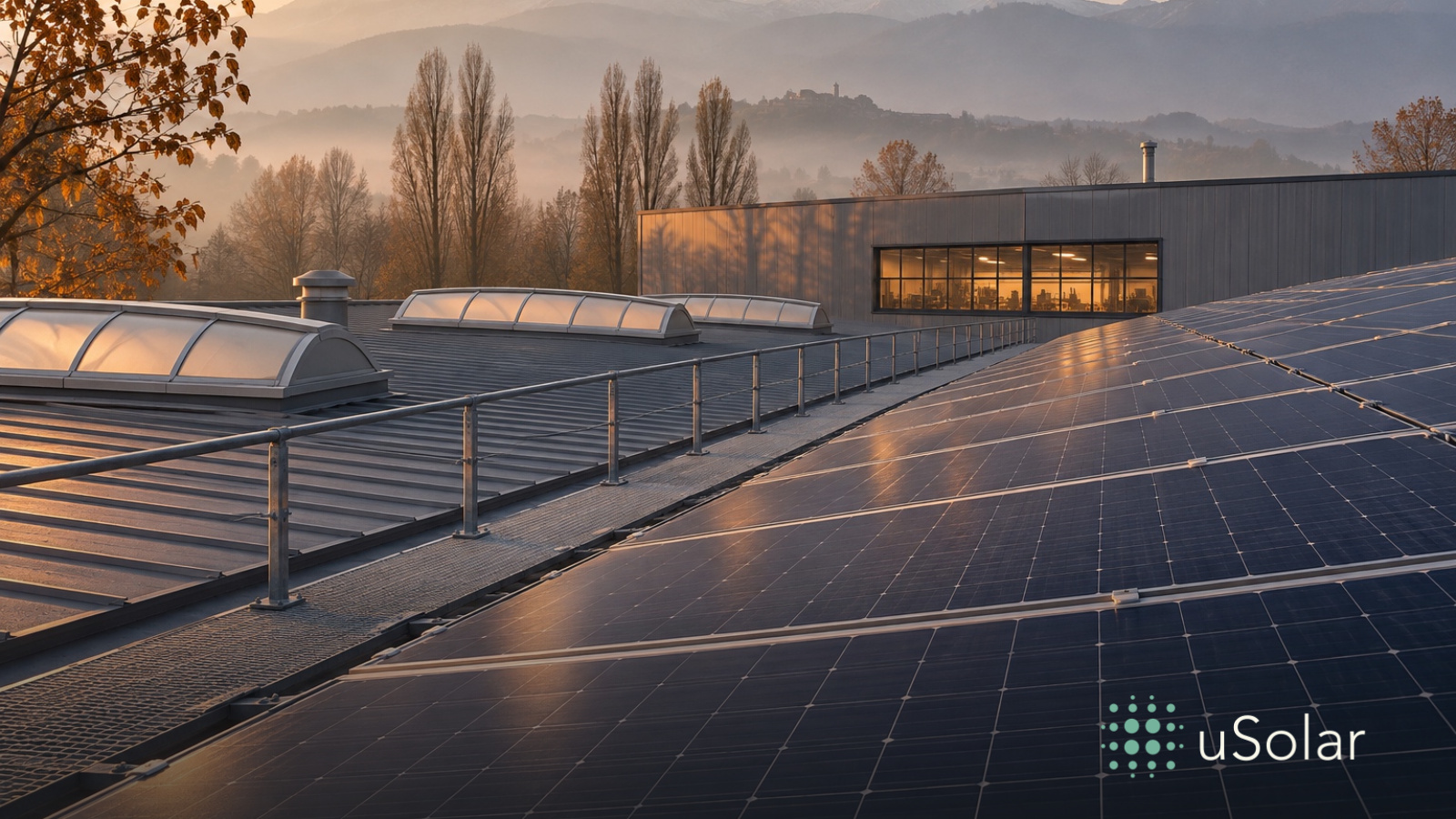
To understand how much the investment really weighs, in uSolar we start from the company’s consumption. How much electricity does the company buy while the roof could produce? What happens on Saturdays, during holidays, or with the second shift? Based on this, an economic plan can be built and it is possible to understand which benefits deserve a check with those who oversee the tax and financing system.
The four questions to bring to the table
Iperammortamento (enhanced tax depreciation)
How much of the cost can I deduct over time? You need an itemised quote, the proposed PV module models and the site’s energy requirements.
New Sabatini Green
What do I finance together with photovoltaic systems? The production program of the SME, the request to the financier and the environmental documentation count.
Renewable energy community (CER)
Who uses electricity in the hours when I export it to the grid? The benefit depends on the energy flows measured once the system is operating and on the community’s rules.
Financing SIMEST
My company exports, or sells to Italian customers who export? Financial statements and documents proving the link with foreign markets are required.
Iperammortamento: check the PV modules and the site’s energy use before calculating the tax benefit
For new equipment used to generate renewable energy for the business’s own consumption, Italy’s iperammortamento increases the cost on which tax deductions are calculated. Battery storage serving the system may also qualify, subject to the applicable requirements and caps. For solar PV, the module model must fall within the categories specified in points b) or c) of Article 12 of Decree-Law 181/2023. Have the exact model code indicated and verify the correspondence in the ENEA register. ENEA Module Registry.
The expected annual production yield must be within 105% of the energy needs of the production facility, calculated using the method in the decree and data from the previous financial year. Compare annual quantities of energy in kWh. The power rating in kW shown in the quote is insufficient for this check.
Work on these systems must be completed between 1 January 2026 and 30 September 2028. The GSE procedure requires advance notification, confirmation and a completion notice. To claim the relief, the completion notice must receive a positive outcome and the equipment must enter service. Implementing Decree, Articles 3, 4 and 8 · MIMIT procedure.
An example of taxation. Suppose the entire €100,000 qualifies, falls in the first band (up to €2.5 million) and receives no other contributions towards the same costs. A 180% uplift gives a total additional deduction of €180,000, spread over the depreciation instalments. The company pays the supplier the agreed price. To estimate the reduction in tax payable, the accountant must apply the company’s tax regime and check when it can use the deductions. Law 199/2025, art. 1, paragraphs 427–436. On the website you can also find the uSolar’s guide to Italy’s iperammortamento.
Sabatini Green: what a workshop includes in its financing matters
Let's go back to the two quotes. Only photovoltaic system. For a normal manufacturing SME, the MIMIT excludes the single purchase of an energy production plant. Inserting the term “Green” in the offer does not change this requirement. The FAQ provides for separate cases for agricultural enterprises and those that produce electricity.
New line and system on the roof. Here a verification can be opened. The company must be able to explain how the purchases form a unified production program, consistent with the activity and the types allowed. The accounting classification of the plant also counts. For the Green bonus, environmental documentation accepted for the process or for the goods is also required. Putting two estimates in the same file, on their own, does not prove the connection. MIMIT FAQ on eligible expenses and Green investments.
The order matters. The SME must submit its application to the bank or participating financial intermediary before starting the investment. The first binding order or advance payment can follow from the day after the transmission. The contribution from the Ministry is calculated conventionally on a five-year financing. For Green investments, the reference rate is 3.575% per annum. The rate that the bank proposes to the company must be read in the financing contract. New Sabatini card from MIMIT.
Renewable energy communities (CER): what is electricity exported from the workshop worth?
An SME can join a renewable energy community if it meets the conditions, including that participation must be ancillary to its main business. To assess eligibility for the premium tariff, check the installation’s eligibility, its capacity (up to 1 MW per incentivised installation), the relevant dates and whether the connection points fall within the area served by the same primary substation.
For a new project, check that the CER was established before the installation entered service. Two buildings being close together is only an initial indication. GSE technical requirements. ARERA integrated text on widespread self-consumption · Economic benefits according to the GSE.
An hour in the workshop, with example numbers
Assume there is one eligible PV installation and no battery. In the hour shown, it generates 80 kWh. The workshop immediately uses 50 kWh on site and exports the remaining 30kWh to the grid. In the same hour, other participants draw 20 kWh from the grid in the area served by the same primary substation.
- 50 kWh They cover on-site consumption and avoid purchasing that amount of electricity from the grid.
- 30 kWh are exported to the grid and can be sold under the producer’s contract.
- 20 of the 30 kWh exported match the participants’ grid imports during that hour. This portion may earn the community’s premium tariff. The other 10 kWh are exported but not shared.
Educational hypothesis, without losses or other factors considered. Unit of measurement: kWh per hour. Definition of self-consumed energy by GSE.
The premium is paid to the configuration for eligible energy over a period of 20 years. The amount an individual business receives depends on the allocation agreement and on the rules governing use of the benefits. Before including this revenue in the financial plan, ask for the rules and a simulation based on the participants’ consumption profiles. GSE distribution rules.
SIMEST. Even those who sell in Italy can be part of an export chain
We’re getting back to the workshop. It sells components to an Italian manufacturer that exports its machinery. Before rejecting SIMEST because its invoices are Italian, it’s worth checking how much that customer accounts for in the turnover. The financing Digital or ecological transition Fund 394/81 supports investments in Italy as well. Among the examples of ecological spending, SIMEST specifically mentions the photovoltaic plant. SIMEST Card · Official examples of investments.
Who can go deeper? Under the standard route, exports must account for at least 10% of turnover in the most recent financial year. Under the supply-chain route, at least 10% of turnover must come from sales to one or more Italian customers, each earning at least 3% of its own turnover from exports. For energy-intensive businesses or those with documented energy-efficiency improvements, the direct export threshold may fall to 3%.
Two complete sets of financial statements (or the equivalent documents specified in the circular) and compliance with the other conditions are also required. For the supply-chain route, ask the customer for evidence of its exports and prepare a breakdown of the invoices issued to that customer. SIMEST Circular, § 2.2.
How much should be returned? The main instrument is a subsidised loan. Normally, at least half of the financing is earmarked for the digital or green transition. Applicants meeting one of the qualifying criteria may receive up to 10% of the financing as a grant, capped at €100,000.
For applications submitted by December 31, 2026 special conditions also apply. For energy-intensive businesses or those undertaking a qualifying energy-efficiency programme, the grant limit is 20%, capped at €200,000. SMEs meeting the specific requirements of the “Energia per la competitività internazionale” measure may receive up to 30%, with the same cap.
In that case, a formal attestation must document either an increase of at least 10% in average unit energy costs or a fall in turnover of at least 10% resulting from the conflict in the Persian Gulf area, over the comparison periods specified in the circular.
The percentage is calculated on the approved financing, within the de minimis headroom available to the applicant. The 31 December deadline applies to these special conditions. SIMEST Circular, definitions and § 3.2.
When can project expenditure begin? For the installation, plan activities, invoices, and payments after receiving the Unique Project Code (CUP). This must be reported on invoices and payments using the dedicated account according to the circular. In the estimate, keep separate costs for the installation, capital to be repaid, and any co-financing granted. SIMEST Circular, §§ 5.1–5.3.
Before placing the order, make two separate calculations
In the first calculation, enter the system cost, the electricity demand covered, revenue from electricity exported to the grid, operating costs and financing. In the second, add only those benefits for which you can identify the beneficiary, calculation basis and conditions, year by year. This shows whether the project remains viable if an application is rejected or the community draws less electricity from the grid than expected.
Which documents to prepare
- Electricity bills, the site’s point-of-delivery (POD) code and its grid import profile, ideally for a full year, together with shift and closure schedules.
- Estimate with separate items for modules, inverters, possible storage, and work on the roof. Also ask for the annual production estimate and the assumptions used.
- List of other requested facilitations, dates of orders and advances, plan for other productive purchases. For the CER, add the connection points and the proposed distribution. For SIMEST, prepare the last two balance sheets, documentation on direct exports or on customers in the supply chain, and the status of aid. de minimis.
Frequently asked questions
Can I combine the four incentives for the same installation?
Adding percentages to the total quote would be misleading. For iperammortamento, the calculation basis must exclude contributions towards the same costs. For Sabatini, SIMEST and the CER tariff, also check each scheme’s rules on combining aid, the aid intensity and any reductions in the premium. Check each cost item for the specific project. In particular, joining a CER does not establish that the producer meets the requirement to generate electricity for its own consumption under iperammortamento. Law 199/2025, paragraph 431 · GSE FAQ on cumulation · SIMEST FAQ on the cumulation with Sabatini.
Can I still request the 40% PNRR for a new CER application?
The national window for that contribution closed the applications on November 30, 2025. For a new project, the tariff for shared energy must be evaluated in accordance with its requirements, separately from the practices already eligible for the capital contribution. Bando and terms published by the GSE.
I have already signed the quote. Where do I start again?
Retrieve the signed order, the receipts for submitting the applications and the dates of any advance payments. For Sabatini, a binding commitment made before the application jeopardizes the eligibility of the program. For the other measures, the sequence provided for by the respective procedure applies. Check the dates with the consultant before adding a benefit to the budget.
How much of your photovoltaic system will work for the company?
If you are considering solar on your facility’s roof, send us the site’s electricity consumption data and shift schedules. We can compare its grid import profile with expected generation and distinguish the electricity you would use on site from the electricity you would export. This gives you a technical basis for discussions with your bank and accountant. Photovoltaic on industrial roof · Contact uSolar.

 Italiano
 English (UK)
 Español
 Deutsch (Sie)
