
01
More self-consumption
It shifts part of the solar energy towards the hours when activity continues and production decreases.
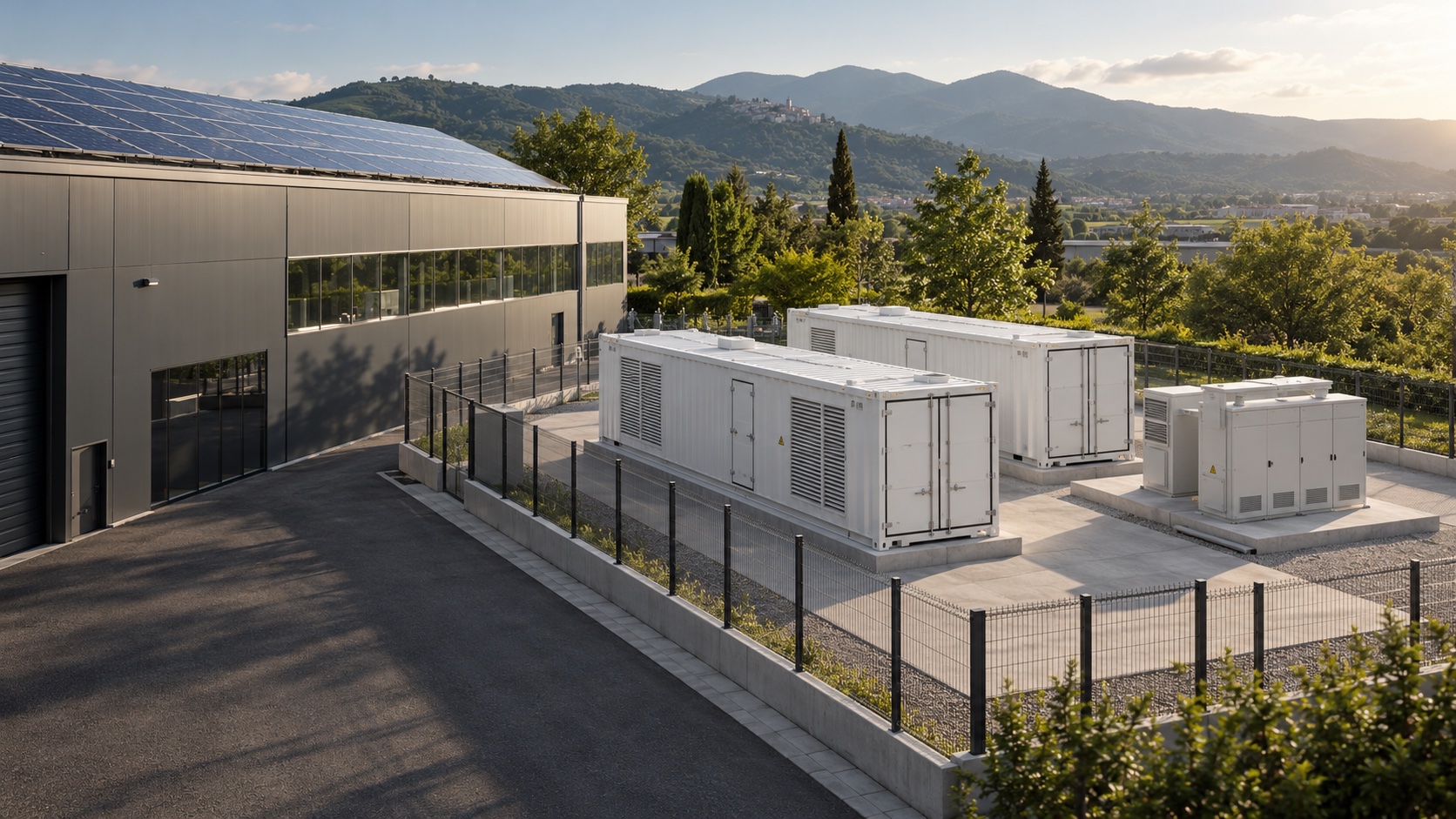
We design industrial BESS around the rhythms of your business. From modular cabinets to container systems: more self-consumption, peak shaving, and industrial backup in pre-configured configurations. A project that brings power, autonomy, and your company’s priorities together.
Industrial BESS systems, Battery Energy Storage System, accumulate part of the available energy to use it later. The value depends on when it is charged, when it is discharged, and what the demand is. We start with consumption, production, and supply conditions.
It shifts part of the solar energy towards the hours when activity continues and production decreases.
Support part of the loads during peak demand periods, within the limits of power, duration, and available charge.
The EMS, the energy management system, governs priorities and limits between photovoltaic systems, storage systems, and compatible loads.
Peak shaving uses the BESS to cover part of the demand when multiple machines are consuming energy together. The goal is to keep the draw from the grid within a defined threshold.
These are the three questions from which we start. The converter must provide the Required kW; The battery must have the Available kWh to support the entire event, even when the peaks occur again in the same round.
In the example, the site would require 500 kW. The BESS provides 150 of them and the grid provides 350. They are needed for half an hour. 150 kW × 0.5 hours = 75 kWh On the AC side. If the peak lasts an hour, the energy requirement doubles.
The economic benefit is assessed based on the cost components that can actually be avoided. Limiting the maximum drawdown can be useful; the bill reduction depends on the contract and the pattern of all the peak periods during the period.
The average power over 15 minutes is an important reference in industrial measurements. A very brief spike and prolonged absorption have different effects: we check the meter and the supply conditions.
After the discharge, it takes time to recover energy. The EMS schedules the recharge by taking advantage of the available margin, avoiding creating a new peak load.
The average control does not replace the instant checks on the cab, cables, protections, and connection. Response times, overload, and apparent power are part of the project.
With an assumed AC/AC cycle efficiency of 90%, recovering the 75 kWh delivered requires approximately 83.3 kWh of charging. At 50 kW constant, approximately 1 hour and 40 minutes are required. To remain below the 350 kW threshold, the site’s net load must leave at least that margin. These are calculation assumptions that must be verified against the actual conditions.
Control systems, refrigeration, essential services or processing to be completed: industrial backup starts with what must remain powered and for how long.
A prepared industrial storage system can support the selected loads during an interruption. The project defines the autonomy, the start-up sequences, and the maximum acceptable interruption time for each user.
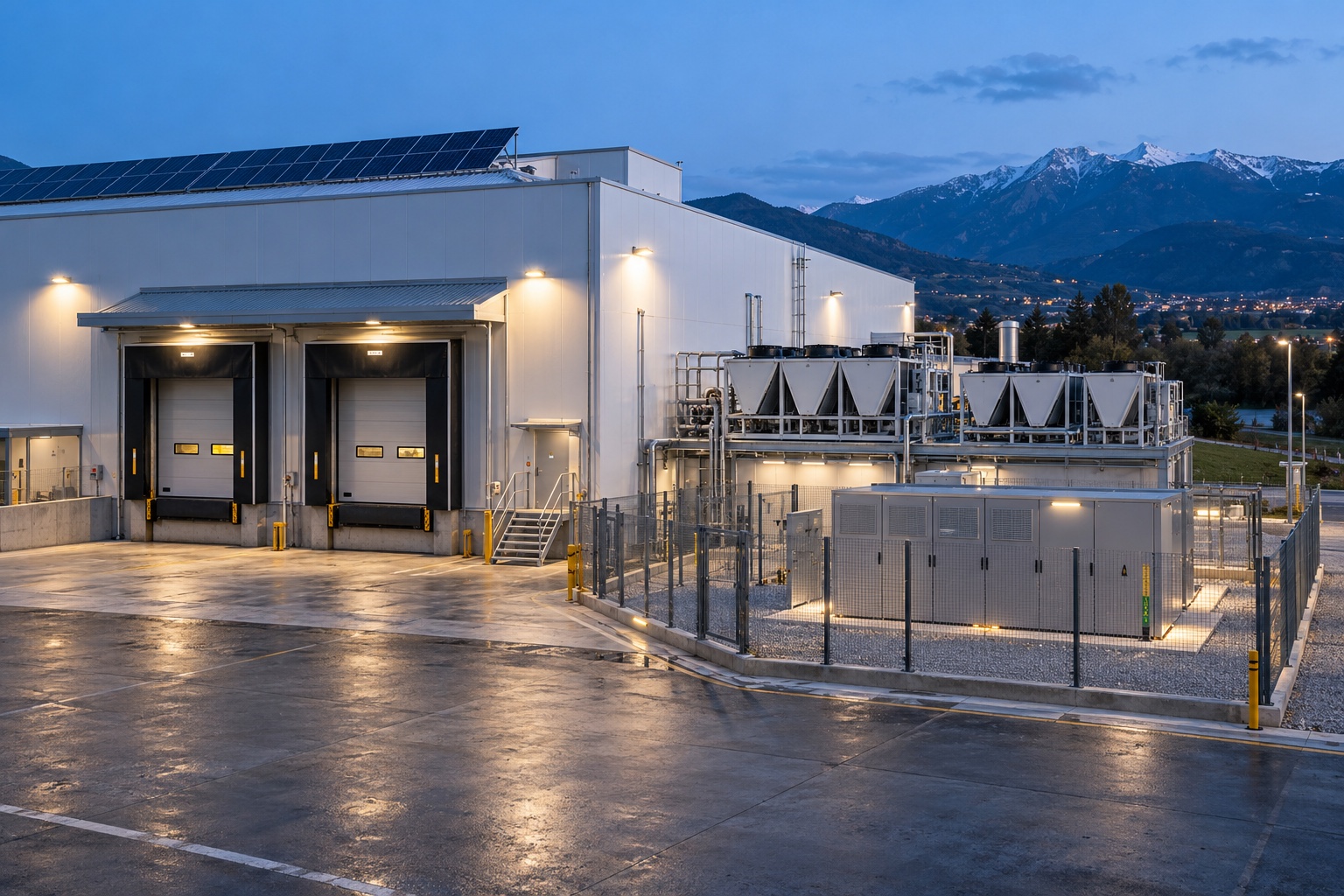
For operation in isolation, isolation from the grid is required, protection is needed, and a source must be provided that establishes voltage and frequency. The BESS must be designed to perform this function, or it must operate with a compatible source.
Failure detection, disconnection, source availability, and load restoration determine the actual interruption. ATS and STS transfer power: they do not create energy and do not guarantee absolute continuity on their own.
Servers, controllers, and sensitive processes may require a dedicated UPS. The BESS can contribute to autonomy in a coordinated architecture. Voltage quality and acceptable interruptions are ensured, in addition to kWh.
On an island, photovoltaic power generation only contributes if the inverter and control systems are compatible. With a generator, start-up, minimum load, and power returns occur. When needed, the control system limits the photovoltaic power generation and inserts the loads in sequence.
With 400 kWh AC available, a constant load of 100 kW corresponds to 4 theoretical hours; at 200 kW it becomes 2 hours. Protecting essential loads can therefore make the reserve more effective. Residual capacity, temperature, auxiliary units and initial state of charge enter the actual calculation. Black start, that is, starting from a deenergized plant, must be verified as a specific function.
Photovoltaic production and the company’s needs do not always coincide. The accumulation shifts part of the surplus to the hours when production decreases and activity continues.
In the scenario, from 12 to 16, 100 kW of surplus are available: 400 kWh AC enters the system. With an assumed cycle efficiency of 90%, 360 are returned, for example at 120 kW from 18 to 21.
This requires real solar excess, available space in the battery, and a consistent nighttime demand. The system must be able to absorb 100 kW and provide 120 kW under the expected conditions.
To estimate the advantage, we compare the avoidable cost of the extraction with the value of the energy that would have been injected into the grid, the losses and costs over time. Even a strategy based on price bands must overcome this comparison.

In industrial BESS systems, the EMS coordinates photovoltaic, battery, grid and compatible loads. It decides when to charge and discharge, respecting power thresholds, charge status and required functions.
The same energy cannot serve two goals simultaneously. If a quota is reserved for the blackout, it should not be consumed to cover the evening shift. Similarly, after a peak, it is necessary to recover energy before the next one.
Priorities can change with shifts, production forecasts, and operational needs. We evaluate the strategy in conjunction with the performance of the system and its capacity over time.
A protected quota leaves room for emergencies; the remaining portion works on ordinary consumption.
The choice concerns the entire system: batteries, power conversion, cooling, control and connection. The external form is only part of the project.
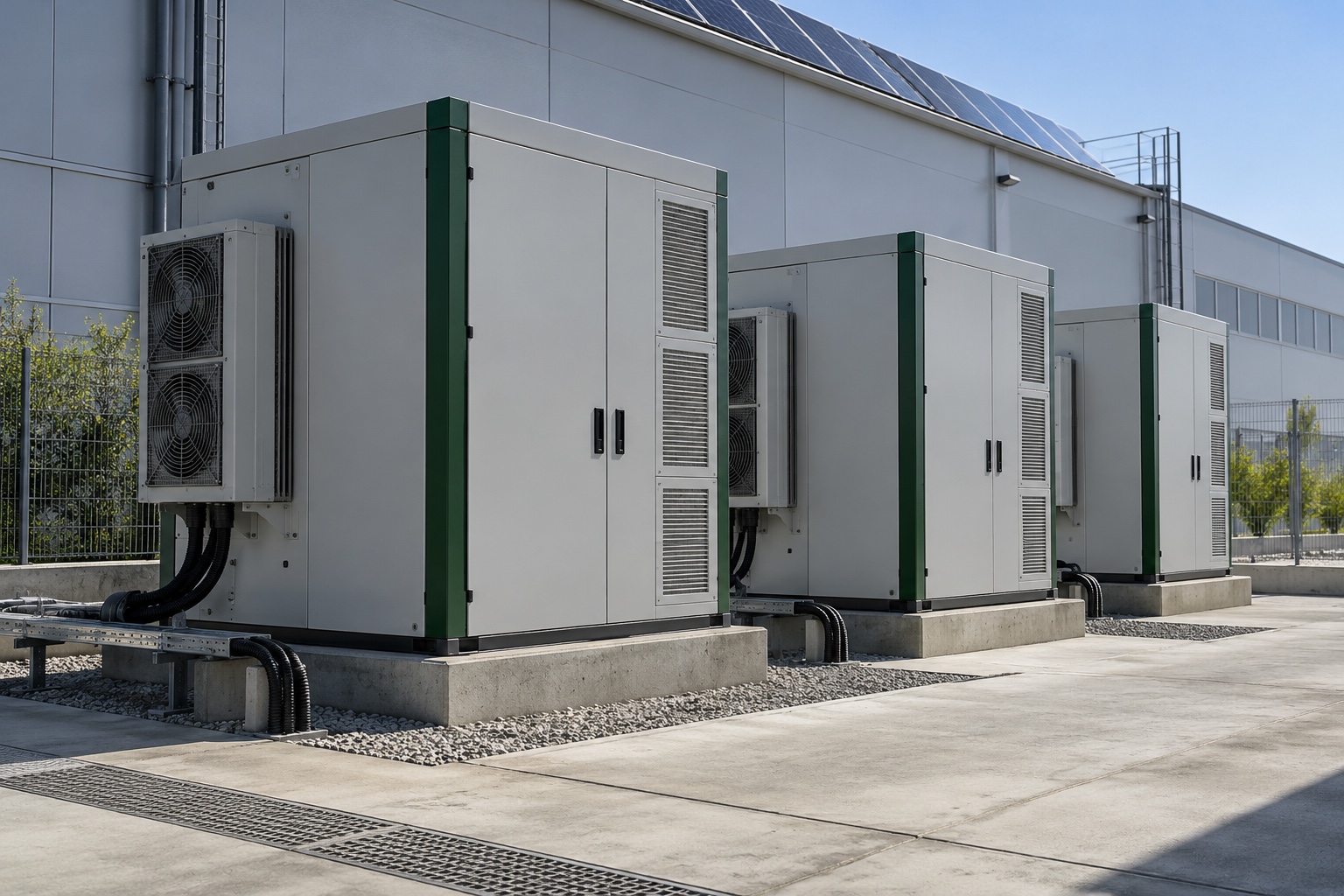
A solution to be considered for distributed technical areas or expansions for compatible units. Overall power, useful capacity, accessibility, and management methods are defined.
To be verified: maintenance areas, distance between units, noise, bases and electrical connections.
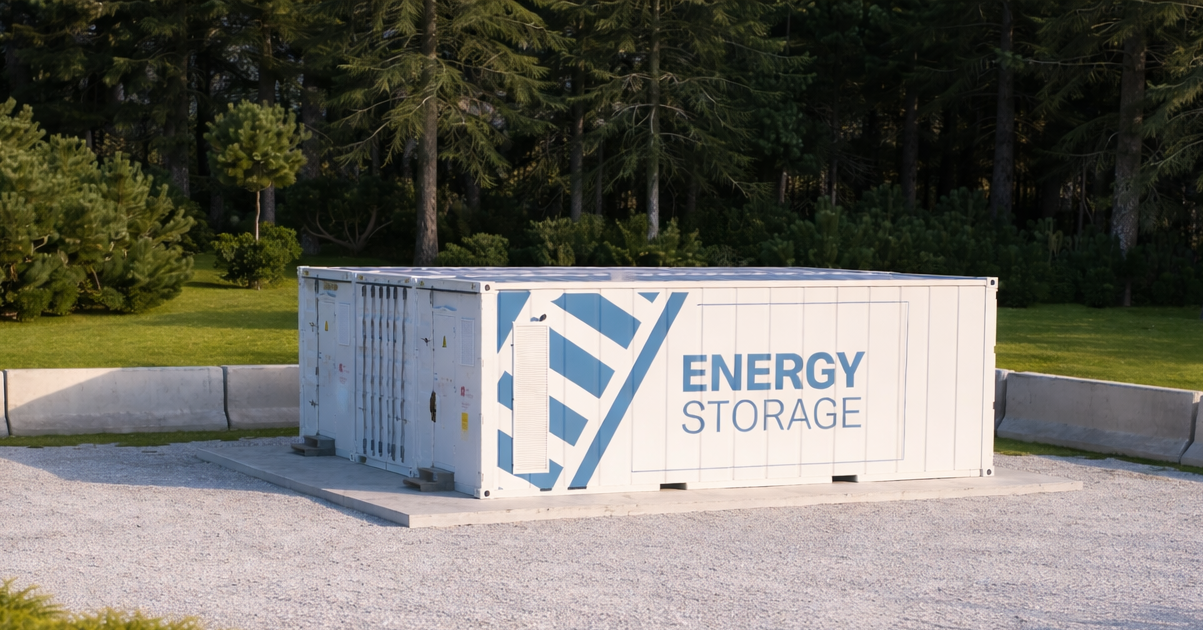
For larger scale projects, with adequate area and access. Battery, PCS, panels and conversion are combined according to the planned architecture, with integrated or separate components.
To be verified: transportation and installation, civil works, cabin, thermal management, safety and connection.
There is no universal threshold that mandates the container. Compare the volume, performance, growth potential, and cost of the complete system. Safety requirements, access for emergency responders, and emergency management are determined by the actual characteristics of the site.
A system with many kWh may not have enough kW to support a peak. And a lot of power, on its own, does not guarantee the required durability.
The sizing also takes into account apparent power, input, losses, reserves, temperature, and degradation. The nominal rated capacity of the panel must be distinguished from the energy actually available to the loads.
Three application contexts to focus on objectives and checks. Each solution is based on the data and priorities of the activity.
Simultaneous start-ups, compressors and lines can meet the demand. The BESS supports part of the peak demand and, with available solar energy, can contribute to the evening shift.
We analyze the duration and repetition of peaks, the margin for charging, and the utilities that must remain supplied.
Demand control complements the needs of conservation and process. The backup configuration distinguishes essential services from tasks that can be postponed.
We verify the required autonomy, the start-up of the compressors and coordination with any UPS or generators.
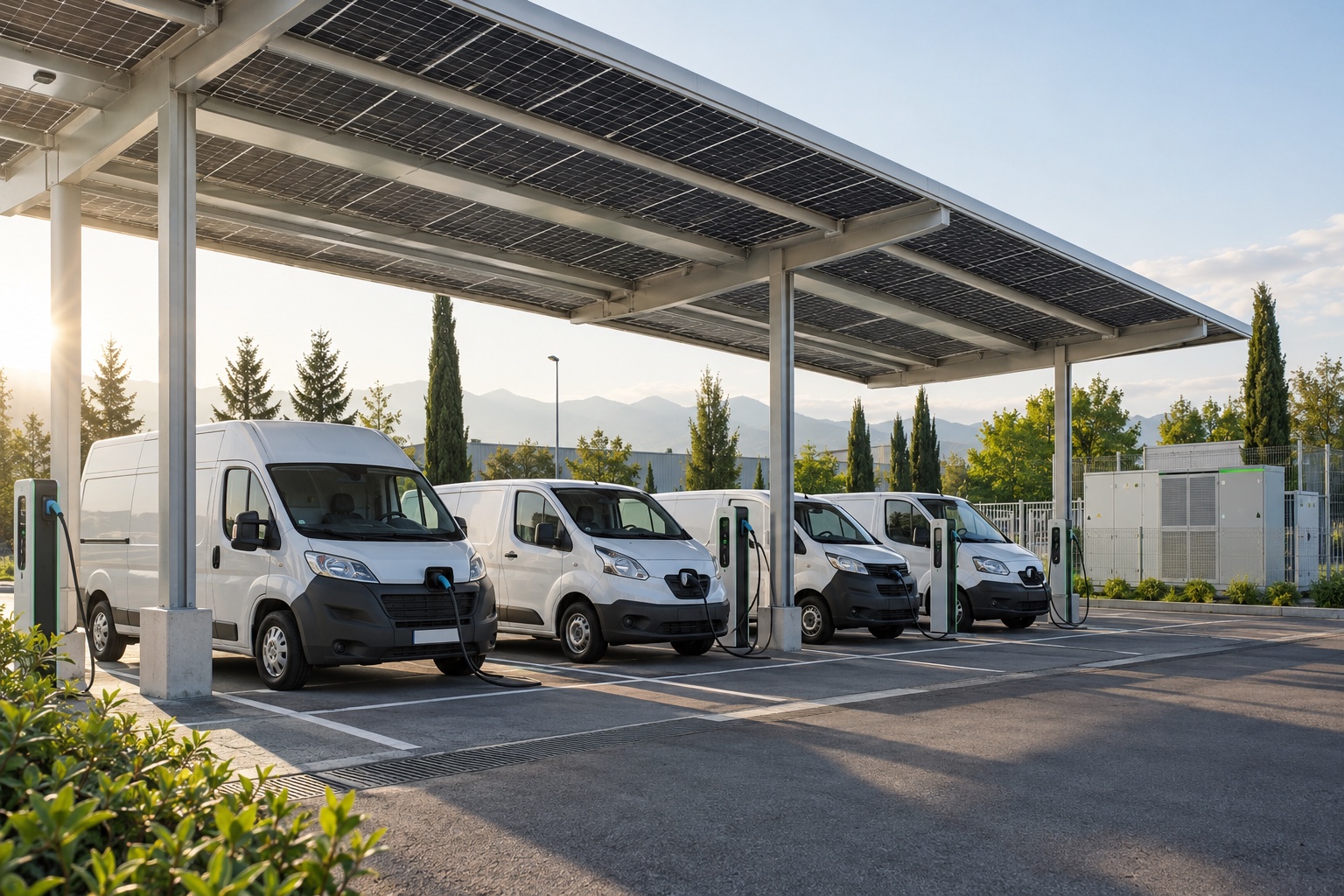
The return of the vehicles concentrates the charging process. The programming of the charging stations, photovoltaic systems and BESS can distribute the demand while respecting departures and priorities.
We verify daily energy, available power, and charging times. The BESS does not automatically eliminate an adjustment to the connection.
An industrial storage project connects site data with the required functions, clarifying expected performance, operational conditions, and planned activities.
Withdrawal and production curves, shifts, repeated peaks, bills and new workloads anticipated.
Self-consumption, withdrawal threshold and backup reserve. Comparison between scenarios, losses and avoidable costs.
Power, capacity, cabin, protections, layout, control and compatibility of the sources.
Testing, monitoring and management criteria. Performance, maintenance and responsibility defined in the proposal.
To deepen the principles: control of peak shaving · power, energy and accumulation · switching between sources.
If you are also considering production, let’s start with the available surfaces and the energy profile of your facility.
It can reduce the maximum relevant charge for some cost components, but the benefit depends on the supply and peak periods. The assessment includes charging energy, losses and management. Containing a single peak does not guarantee a monthly savings.
The maximum does not indicate how long it lasts or how many times it repeats; annual kWh do not show when they are needed. Time series are required and, for rapid transients, more detailed measurements are necessary. Electricity patterns and limits require dedicated verification.
Yes, if the system and controls allow it, by defining priority and energy quotas. Using the entire reserve for the evening shift can leave little margin for the next peak or a blackout. The EMS also coordinates the recharge.
Backup must be planned into the project. It requires island operation, separation from the network, protections, load management, and an adequate reserve. It is determined whether to protect the entire site or just certain facilities, and how long of an interruption they can tolerate.
The STS transfers the load to an available alternative source, under the specified conditions. The result depends on the entire chain, including the detection and start-up of the source. For sensitive applications, there are time constraints, voltage quality issues, and the need for a dedicated UPS.
It is possible in compatible architectures. The local network must have a stable reference and a control capable of balancing production, loads, and available power. If the battery is full and consumption is low, it may be necessary to limit photovoltaic power.
It is often possible, after checking the equipment. For the generator, control, load limits, and power returns are taken into account. For the motors, currents and start-up duration, sequences, and the converter’s overload capacity are evaluated.
Power, capacity, space, access, security, and connectivity are compared. There is no universal threshold: the comparison concerns the complete system, including civil works, power conversion, and expansion possibilities.
Tell us about your consumption, shifts, existing photovoltaic systems, and loads to protect. Together we assess how a BESS can contribute to the energy and continuity of your business.
To get started: consumption and production curves, supply conditions, electrical schematic and backup priority, if required.
 Italiano Italiano
 English (UK)
 Español
 Deutsch (Sie) Italiano Italiano English (UK)
Español
Deutsch (Sie)

We use cookies to improve your experience on our site. By using our site, you consent to the use of cookies.
Manage your cookie preferences below:
Essential cookies enable basic functions and are necessary for the proper functioning of the website.
These cookies are required for adding comments to this website.
Statistics cookies collect information anonymously. This information helps us to understand how visitors use our website.
Google Analytics is a powerful tool that tracks and analyses website traffic for informed marketing decisions.
Service URL: policies.google.com (opens in a new window)
Puoi trovare maggiori informazioni nella nostra Privacy Policy and in our Privacy Policy.